Lesson 1
Central Idea
Key Scripture
Student Formation
1 of 24

A four-year theological formation pathway helping students understand Scripture, walk faithfully with Christ, grow in wisdom and discernment, and learn to lead and care for others within the story of Scripture.
In Verbo Vivimus — In the Word we live.

The curriculum portal brings the four-year Achten Häus pathway into one organized place. Students can move through courses and formation threads, while teachers can access teaching guides, resources, and supporting materials without relying on a stack of separate files.
Achten Häus serves churches, Christian schools, and families seeking serious theological formation for high school students.
Students are formed to live within the story of Scripture—learning to see reality as God reveals it, rather than as the world defines it.
Head — Knowledge
Heart — Abiding in Christ and walking with Him inside the story
Hands — Ministering to others
The course keeps these together rather than treating theological education as information alone.
Old Testament Survey • New Testament Survey
Hermeneutics • Greek Tools • Hebrew Tools
Church History • Philosophy • Systematic Theology • Ethics
Apologetics • Biblical Counseling and Care • Leadership • Missions • Communication
Each semester intentionally develops these formation threads alongside the primary course of study. Select a thread to explore its 24 formation lessons.
The twenty-week New Testament semester moves from the Gospels through Acts, Romans, the Epistles, Hebrews, the Catholic Epistles, and Revelation, ending with a deliberate call to respond and follow Christ.
Twenty weeks through Torah, Prophets, and Writings, tracing creation, promise, covenant, kingdom, exile, hope, and the unfinished expectation that carries the story toward the New Testament.
Year 1 · Semester 1 — New Testament Survey. Each week integrates survey, apprenticeship, journal work, vocabulary, and formation.
Read • See • Understand • Receive • Respond
The Old Testament ends with waiting. Jesus arrives as the promised King.
Jesus is the promised King—and His kingdom has come.
Jesus shows… then explains.
Watch how His teaching explains His actions.
Mon: Matthew 1-4 | Tue: 5-7 | Wed: 8-10 | Thu: 11-13 | Fri: 14-17
Matthew 5–7 — What kind of life belongs in Jesus’ kingdom?
“Follow me.” Jesus is inviting you to follow Him and orient your life around His Kingdom.
Matthew 4:18–22
Christian leadership begins under Christ’s authority: before we lead others, we learn to follow Jesus.
HEAD HEART HANDS STORY
What kind of King is Jesus?
What is hardest to obey?
What is one thing I will do this week?
Matthew 1–10 — The King Has Arrived
Establish how the class works
Jesus is the promised King
and His kingdom has come.
understanding the class rhythm
beginning to see who Jesus is
recognizing that following Him requires response
OPENING + FRAMEWORK (0:00–0:15)
“This class is not just about learning information.
We are learning to read Scripture, understand it, and live inside it.”
Read
See
Understand
Receive
Respond
Brief prayer
ORIENTATION TO MATTHEW (0:15–0:20)
“The Old Testament ends with waiting.
Matthew begins by showing us that the promised King has come.”
“Watch how Jesus acts—and then how He teaches.”
READING THE TEXT (0:20–0:35)
Matthew 1:18–25 (birth of Jesus)
Matthew 4:18–22 (call to follow)
Matthew 5:1–12 (Beatitudes — anchor)
Matthew 7:24–27 (wise and foolish builder)
“As we read, ask: What kind of King is Jesus?”
OBSERVE (0:35–0:55)
What stands out about how Jesus begins His ministry?
What kind of people does He call?
What kind of life does He describe in Matthew 5?
Jesus calls ordinary people
His kingdom is different than expected
His teaching focuses on the heart
Let students speak first—guide gently
UNDERSTAND (0:55–1:10)
What does this show us about Jesus as King?
Is this what people expected from a king?
What kind of life belongs in His kingdom?
“Jesus is not just a teacher—He is the King.”
“And His kingdom is not just outward—it changes the heart.”
Kingdom — God’s rule and reign through Jesus
RECEIVE (1:10–1:15)
Pause.
“Take a moment—what are you seeing about Jesus?”
(30–60 seconds silence)
What kind of King is Jesus? (from booklet)
What is hardest to obey? (from booklet)
Keep this connected to their weekly reflection
“What is one thing you will do this week in response to Jesus?”
“Follow me.”
“This week, don’t just read—pay attention to how Jesus is calling you to follow Him.”
keep things simple
establish the class rhythm clearly
connect everything back to Jesus
allow students to speak
Use HEAD, HEART, HANDS, and STORY each day as you work through the week's reading.
Entries are saved automatically in this browser.
Core New Testament vocabulary for this week.
Explain each term in your own words and connect it to this week’s New Testament reading.
Read • See • Understand • Receive • Respond
The Gospel According to Matthew
The King has come and revealed His kingdom.
Now we begin to see how people respond to Him.
Jesus is the King—but not everyone receives His kingdom.
Watch how different people respond to Jesus.
Some follow—others resist.
Mon: Matthew 18 | Tue: 19-22 | Wed: 23-25 | Thu: 26-27 | Fri: 28
Matthew 13 — Why do some receive the kingdom and others do not?
Following Jesus means hearing and responding.
Matthew 28:18–20
Jesus sends His followers to make disciples of all nations; mission belongs to the normal life of discipleship.
HEAD HEART HANDS STORY
Why do some people reject Jesus?
Where do I resist Him?
What is one thing I will do this week?
Matthew 11–28 — The King Is Received and Rejected
Jesus is the King—but not everyone receives Him.
people respond differently to Jesus
hearing is not the same as responding
following Jesus requires real reception, not just exposure
“Last week we saw that Jesus is the King and what His kingdom is like.
This week we begin to see how people respond to Him.”
Pray briefly.
“As Jesus continues His ministry, not everyone responds the same way.”
“Some listen and follow. Others hear—but resist.”
“Watch the difference between hearing and responding.”
Matthew 11:28–30 (Come to Me)
Matthew 13:1–23 (Parable of the sower — anchor)
Matthew 16:13–17 (Who do you say I am?)
Matthew 21:33–46 (Rejection of the Son)
“As we read, ask: Why do some people receive Jesus—and others do not?”
What different responses do you see to Jesus?
What happens in the parable of the sower?
What kind of people receive the message?
some hear but don’t understand
some respond briefly but fall away
some are distracted
some truly receive
Let students describe before you explain
What makes the difference between these responses?
Why doesn’t everyone receive the kingdom?
What does it mean to truly “hear”?
“Hearing Jesus is not the same as receiving Him.”
“The difference is not information—it is response.”
Receive — to truly hear, accept, and respond to Jesus
Pause.
“Take a moment—where do you see yourself in these responses?”
(30–60 seconds silence)
Why do some people reject Jesus?
Where do I resist Him?
What distracts people from truly receiving Jesus?
“What is one way you need to respond to Jesus this week—not just hear Him?”
Keep it simple and personal
“This week, pay attention not just to what you read—but how you respond.”
keep the focus on responses to Jesus
let students identify patterns
connect everything back to personal response
Use HEAD, HEART, HANDS, and STORY each day as you work through the week's reading.
Entries are saved automatically in this browser.
Core New Testament vocabulary for this week.
Explain each term in your own words and connect it to this week’s New Testament reading.
Read • See • Understand • Receive • Respond
The Gospel According to Mark
We have seen who Jesus is as King.
Now we watch what He does.
Jesus is powerful—but calls us to follow Him through suffering.
Mark moves quickly.
Watch the action—and the turning point in chapter 8.
Watch for the Markan Sandwiches
Mon: Mark 1–3 | Tue: 4–6 | Wed: 7–9 | Thu: 10–12 | Fri: 13–16
Mark 8:27–38 — Who do you say that I am?
Following Jesus means taking up your cross.
Mark 10:35–45
Jesus overturns worldly ideas of greatness: Christian leadership uses influence to serve rather than dominate.
HEAD HEART HANDS STORY
Who do I say Jesus is?
What does following Him cost?
What is one thing I will do this week?
Mark 1–16 — The King in Action
Jesus is powerful—but following Him leads through suffering.
who Jesus is must be personally answered
following Him has a cost
power and suffering are connected
“We’ve seen who Jesus is and how people respond.
Now we watch what He actually does.”
Pray briefly.
“Mark moves quickly—action after action.”
Who do you say that I am?”
Mark 1:14–20 (call to follow)
Mark 4:35–41 (Jesus’ authority)
Mark 8:27–38 (anchor — turning point)
Mark 10:32–45 (suffering and service)
“As we read, watch what Jesus does—and how people respond.”
🟥 4. OBSERVE (0:30–0:50)
What stands out about what Jesus does?
How do people react to His power?
What happens in chapter 8?
Jesus has authority over everything
people are amazed—but confused
disciples misunderstand
turning point: identity + suffering
Why is Peter’s statement so important?
Why does Jesus immediately talk about suffering?
What does it mean to “take up your cross”?
“Knowing who Jesus is leads to following Him.”
“Following Him means surrender—not comfort.”
Disciple — one who follows Jesus and learns from Him
Pause.
“Take a moment—what is hardest about following Jesus?”
Who do I say Jesus is?
What does following Him cost?
“What is one way you need to follow Jesus more seriously this week?”
WEEK 3 WIN
see Jesus clearly
wrestle with cost
begin personal commitment
Use HEAD, HEART, HANDS, and STORY each day as you work through the week's reading.
Entries are saved automatically in this browser.
Core New Testament vocabulary for this week.
Explain each term in your own words and connect it to this week’s New Testament reading.
Read • See • Understand • Receive • Respond
The Gospel according to Luke
We have seen Jesus’ power and the cost of following Him.
Now we see who He came for.
Jesus is the Savior for all—especially the outsider.
Watch who Jesus notices.
Pay attention to those others overlook.
Mon: Luke 1–3 | Tue: 4–6 | Wed: 7–9 | Thu: 10–15 | Fri: 16–24
Luke 15 — What is God like toward the lost?
Following Jesus means caring about the people He cares about.
Luke 3:21–22; 4:1, 14–21; 7:11–17; 10:25–37
Jesus lives in submission to the Father and the power of the Spirit, and that life moves outward in compassion toward people.
HEAD HEART HANDS STORY
Who does Jesus pursue?
Who do I overlook?
What is one thing I will do this week?
Luke 1–24 — The Savior for All
Jesus came for all—especially the overlooked and lost.
who Jesus notices
what God is like toward the lost
how their hearts align (or don’t) with His
🟩 1. OPENING (0:00–0:10)
“We’ve seen Jesus’ power and the cost of following Him.
Now we see who He came for.”
Pray briefly.
🟨 2. ORIENTATION (0:10–0:15)
“Luke shows us the people others ignore—
and how Jesus responds to them.”
🟦 3. READING THE TEXT (0:15–0:30)
Luke 4:16–21 (mission)
Luke 7:36–50 (forgiveness)
Luke 10:25–37 (Good Samaritan)
Luke 15:1–32 (anchor — lost)
“As we read, watch who Jesus notices.”
🟥 4. OBSERVE (0:30–0:50)
Who does Jesus interact with?
Who do others ignore or reject?
What happens in Luke 15?
sinners, outsiders, broken people
religious leaders miss it
God actively seeks the lost
🟪 5. UNDERSTAND (0:50–1:10)
What do these stories show about God?
Why do some people struggle with this?
What is the attitude of the older brother?
“God is not distant—He pursues.”
“Following Jesus means caring about who He cares about.”
Compassion — caring deeply and moving toward others
⬛ 6. RECEIVE (1:10–1:15)
Pause.
“Who do you tend to overlook?”
🟫 7. DISCUSS (1:15–1:25)
Who does Jesus pursue?
Who do I overlook?
🟩 8. RESPOND (1:25–1:30)
“What is one way you can care about someone this week that you normally wouldn’t?”
🎯 WEEK 4 WIN
see God’s heart
recognize bias/blind spots
move toward others
📄
Use HEAD, HEART, HANDS, and STORY each day as you work through the week's reading.
Entries are saved automatically in this browser.
Core New Testament vocabulary for this week.
Explain each term in your own words and connect it to this week’s New Testament reading.
Read • See • Understand • Receive • Respond
The Gospel According to John
We have seen who Jesus is, what He does, and who He came for.
Now we are invited to believe in Him and receive life.
Jesus is the Son of God—and life is found in Him.
Watch for what Jesus says about Himself.
Follow the repeated call to believe.
Mon: John 1–3 | Tue: 4–6 | Wed: 7–10 | Thu: 11–14 | Fri: 15–21
John 15 — What does it mean to abide in Jesus?
Following Jesus means remaining in Him.
John 15:1–11
Christian fruitfulness grows from abiding in Christ, not from trying to manufacture spiritual life by our own strength.
HEAD HEART HANDS STORY
What does it mean to believe in Jesus?
Am I abiding in Him or drifting from Him?
What is one thing I will do this week?
John 1–21 — Life in the Son
Achten Häus
New Testament Apprenticeship Guide — Teacher Flow
🎯 PRIMARY GOAL
Life is found in Jesus—and must be received by believing and abiding.
who Jesus claims to be
what belief really means
what it means to abide in Him
⏱️ CLASS FLOW
🟩 1. OPENING (0:00–0:10)
“We’ve seen who Jesus is, what He does, and who He came for.
Now we are invited to believe in Him and receive life.”
Pray briefly.
🟨 2. ORIENTATION (0:10–0:15)
“John focuses on belief.”
“Watch what Jesus says about Himself—and how people respond.”
🟦 3. READING THE TEXT (0:15–0:30)
John 1:1–14 (Word)
John 3:1–16 (new life)
John 10:7–18 (shepherd)
John 15:1–11 (anchor — abide)
“As we read, ask: What does it mean to believe?”
🟥 4. OBSERVE (0:30–0:50)
What does Jesus say about Himself?
What words repeat?
How do people respond to Him?
strong identity claims
belief vs unbelief
life vs death
connection imagery (vine/branches)
🟪 5. UNDERSTAND (0:50–1:10)
What does it mean to believe?
What does it mean to abide?
What happens if we disconnect from Jesus?
“Belief is trust—not just knowledge.”
“Abiding means staying connected to Jesus.”
Abide — to remain connected to Jesus
⬛ 6. RECEIVE (1:10–1:15)
Pause.
“Where do you feel disconnected from Jesus?”
🟫 7. DISCUSS (1:15–1:25)
What does it mean to believe in Jesus?
Am I abiding or drifting?
🟩 8. RESPOND (1:25–1:30)
“What is one way you can stay connected to Jesus this week?”
🎯 WEEK 5 WIN
understand belief as trust
begin to grasp abiding
recognize spiritual drift
Use HEAD, HEART, HANDS, and STORY each day as you work through the week's reading.
Entries are saved automatically in this browser.
Core New Testament vocabulary for this week.
Explain each term in your own words and connect it to this week’s New Testament reading.
Read • See • Understand • Receive • Respond
Acts of the Apostles
Jesus has died, risen, and ascended.
Now His work continues through His people.
Jesus continues His work through His people by the Spirit.
Watch how the Spirit leads and empowers.
Follow the spread of the gospel.
Mon: Acts 1–5 | Tue: 6–10 | Wed: 11–15 | Thu: 16–20 | Fri: 21–28
Acts 2 — What changes when the Spirit comes?
Following Jesus means participating in His mission.
Acts 1:8; 8; 10; 13
The Spirit carries the gospel across geographical, ethnic, social, and cultural boundaries.
HEAD HEART HANDS STORY
What is the Spirit doing?
Where is God inviting me to join Him?
What is one thing I will do this week?
Acts 1–28 — Empowered for the Mission
Achten Häus
New Testament Apprenticeship Guide — Teacher Flow
🎯 PRIMARY GOAL
Jesus continues His work through His people by the Spirit.
the role of the Holy Spirit
that the mission continues through believers
that following Jesus includes participating in His work
⏱️ CLASS FLOW
🟩 1. OPENING (0:00–0:10)
“We’ve seen who Jesus is and what it means to follow Him.
Now we see how His work continues.”
Pray briefly.
🟨 2. ORIENTATION (0:10–0:15)
“Acts shows us what happens after Jesus ascends.”
“Watch how the Spirit leads—and how the gospel spreads.”
🟦 3. READING THE TEXT (0:15–0:30)
Acts 1:6–11 (commission)
Acts 2:1–13 (anchor — Spirit comes)
Acts 4:23–31 (boldness)
Acts 13:1–3 (mission begins)
“As we read, watch what changes when the Spirit comes.”
🟥 4. OBSERVE (0:30–0:50)
What happens in Acts 2?
What changes in the disciples?
How does the message spread?
fear → boldness
Spirit empowers
gospel moves outward
🟪 5. UNDERSTAND (0:50–1:10)
What is the role of the Spirit?
Is this just for the apostles—or all believers?
What is the mission of the church?
“Jesus is still working—through His people.”
“The Spirit empowers us to participate in His mission.”
Holy Spirit — God’s presence with and in His people
⬛ 6. RECEIVE (1:10–1:15)
Pause.
“Where do you need God’s help to follow Him?”
🟫 7. DISCUSS (1:15–1:25)
What is the Spirit doing?
Where is God inviting me to join Him?
🟩 8. RESPOND (1:25–1:30)
“What is one way you can step into what God is doing this week?”
🎯 WEEK 6 WIN
see the Spirit’s role
understand mission
begin to see themselves as participants
📄
Use HEAD, HEART, HANDS, and STORY each day as you work through the week's reading.
Entries are saved automatically in this browser.
Core New Testament vocabulary for this week.
Explain each term in your own words and connect it to this week’s New Testament reading.
Read • See • Understand • Receive • Respond
Romans
We have seen Jesus and the mission of His people.
Now we begin to understand what it all means.
God reveals His righteousness through Jesus Christ.
Slow down and follow Paul’s argument.
Watch how each idea builds on the one before it.
Mon: Romans 1 | Tue: 2 | Wed: 3–4 | Thu: 5–6 | Fri: 7–8
Romans 3:21–26 — How are we made right with God?
Following Jesus means trusting what He has done for you.
Romans 5–6; 8
God first declares what He has done for us and who we are in Christ; Christian obedience grows out of that grace and identity.
HEAD HEART HANDS STORY
What has God done to make me right with Him?
Where do I trust myself instead of Him?
What is one thing I will do this week?
Romans 1–8 — Righteousness Revealed
Achten Häus
New Testament Apprenticeship Guide — Teacher Flow
🎯 PRIMARY GOAL
God makes us right with Him through Jesus—not through ourselves.
the problem of sin
God’s solution in Christ
the meaning of righteousness
⏱️ CLASS FLOW
🟩 1. OPENING (0:00–0:10)
“We’ve seen Jesus and the mission—now we understand what it all means.”
Pray briefly.
🟨 2. ORIENTATION (0:10–0:15)
“Romans is different—it builds an argument.”
“Follow how each idea connects.”
🟦 3. READING THE TEXT (0:15–0:30)
Romans 1:16–17 (gospel power)
Romans 3:21–26 (anchor — justification)
Romans 5:6–11 (Christ died for us)
Romans 8:1–4 (no condemnation)
“As we read, ask: How are we made right with God?”
🟥 4. OBSERVE (0:30–0:50)
What problem does Paul describe?
What does God do about it?
What repeats? (sin, righteousness, faith)
all are sinful
God provides righteousness
through Jesus
🟪 5. UNDERSTAND (0:50–1:10)
What does “righteousness” mean here?
Why can’t we make ourselves right?
What does Jesus accomplish?
“We are made right with God by what Jesus has done—not by what we do.”
Righteousness — being made right with God
⬛ 6. RECEIVE (1:10–1:15)
Pause.
“Where do you try to rely on yourself instead of God?”
🟫 7. DISCUSS (1:15–1:25)
What has God done to make me right?
Where do I trust myself instead of Him?
🟩 8. RESPOND (1:25–1:30)
“What is one way you can trust what Jesus has done this week?”
🎯 WEEK 7 WIN
understand the gospel clearly
see their need
begin to trust Christ
📄
Use HEAD, HEART, HANDS, and STORY each day as you work through the week's reading.
Entries are saved automatically in this browser.
Core New Testament vocabulary for this week.
Explain each term in your own words and connect it to this week’s New Testament reading.
Read • See • Understand • Receive • Respond
Romans
We have seen how God makes us right through Christ.
Now we see how we are to live in response.
Those made right with God are called to live transformed lives.
Follow how Paul moves from truth to living.
Watch how belief shapes behavior.
Mon: Romans 9–10 | Tue: 11–12 | Wed: 13–14 | Thu: 15–16 | Fri: Reflect
Romans 12:1–2 — What does a transformed life look like?
Following Jesus means offering your whole life to Him.
Romans 12:9–21; 13:8–10
Christian ethics is shaped by sincere love that seeks the true good of God and neighbor.
HEAD HEART HANDS STORY
How should I respond to God’s mercy?
Where is my life not yet surrendered to Him?
What is one thing I will do this week?
Romans 9–16 — Living in Light of Mercy
Achten Häus
New Testament Apprenticeship Guide — Teacher Flow
🎯 PRIMARY GOAL
Those made right with God are called to live transformed lives.
truth leads to transformation
belief shapes behavior
following Jesus involves surrender
⏱️ CLASS FLOW
🟩 1. OPENING (0:00–0:10)
“We’ve seen how God makes us right.
Now we see how we live in response.”
Pray briefly.
🟨 2. ORIENTATION (0:10–0:15)
“Paul moves from what God has done—to how we live.”
🟦 3. READING THE TEXT (0:15–0:30)
Romans 9:14–16 (God’s mercy)
Romans 12:1–2 (anchor — transformed life)
Romans 13:8–10 (love)
Romans 15:1–7 (living together)
“As we read, ask: How should we respond to God’s mercy?”
🟥 4. OBSERVE (0:30–0:50)
What changes after chapter 11?
What kind of life is described?
What is emphasized?
surrender
transformation
love
community
🟪 5. UNDERSTAND (0:50–1:10)
What does it mean to offer your life to God?
What does transformation look like?
How does truth shape behavior?
“Following Jesus means offering your whole life—not just parts.”
Transformation — a changed life shaped by God
⬛ 6. RECEIVE (1:10–1:15)
Pause.
“What part of your life is hardest to surrender?”
🟫 7. DISCUSS (1:15–1:25)
How should I respond to God’s mercy?
Where is my life not yet surrendered?
🟩 8. RESPOND (1:25–1:30)
“What is one area you need to offer to God this week?”
🎯 WEEK 8 WIN
see response clearly
identify areas of surrender
connect belief to life
📄
Use HEAD, HEART, HANDS, and STORY each day as you work through the week's reading.
Entries are saved automatically in this browser.
Core New Testament vocabulary for this week.
Explain each term in your own words and connect it to this week’s New Testament reading.
Read • See • Understand • Receive • Respond
1 Corinthians
We have seen what God has done and how we are to live.
Now we see what that looks like inside a real church.
God calls His people to live faithfully in every area of life.
Watch how Paul addresses real problems.
Follow how truth is applied to everyday situations.
Mon: 1 Corinthians 1–3 | Tue: 4–6 | Wed: 7–9 | Thu: 10–12 | Fri: 13–16
1 Corinthians 1:18–25 — What is true wisdom?
Following Jesus means living differently from the world.
1 Corinthians 1:18–31; 2:6–16
God’s wisdom in Christ challenges the assumptions and standards by which the world decides what is wise.
HEAD HEART HANDS STORY
Where is my thinking shaped by the world instead of God?
Where does my life not reflect Christ?
What is one thing I will do this week?
1 Corinthians 1–16 — Living as God’s People
Achten Häus
New Testament Apprenticeship Guide — Teacher Flow
🎯 PRIMARY GOAL
Following Jesus means living differently from the world—especially together.
the difference between worldly and godly thinking
how truth applies in real life
what it means to live as God’s people
⏱️ CLASS FLOW
🟩 1. OPENING (0:00–0:10)
“We’ve seen how we are to live—now we see what that looks like in a real church.”
Pray briefly.
🟨 2. ORIENTATION (0:10–0:15)
“1 Corinthians deals with real problems.”
“Watch how truth is applied to everyday life.”
🟦 3. READING THE TEXT (0:15–0:30)
1 Corinthians 1:18–25 (anchor — wisdom)
1 Corinthians 3:1–9 (spiritual maturity)
1 Corinthians 6:12–20 (living differently)
1 Corinthians 12:12–27 (body)
“As we read, ask: What does it mean to live as God’s people?”
🟥 4. OBSERVE (0:30–0:50)
What problems does Paul address?
How do people think differently than God?
What stands out about the church?
division
immaturity
worldly thinking
need for unity
🟪 5. UNDERSTAND (0:50–1:10)
What is true wisdom?
Why do believers struggle to live differently?
What does it mean to be the body of Christ?
“Following Jesus changes how we think—and how we live together.”
Church — the people of God who follow Jesus
⬛ 6. RECEIVE (1:10–1:15)
Pause.
“Where is your thinking shaped more by the world than by God?”
🟫 7. DISCUSS (1:15–1:25)
Where is my thinking shaped by the world?
Where does my life not reflect Christ?
🟩 8. RESPOND (1:25–1:30)
“What is one way you need to live differently this week?”
🎯 WEEK 9 WIN
see real-life application
recognize worldly influence
begin living differently
Use HEAD, HEART, HANDS, and STORY each day as you work through the week's reading.
Entries are saved automatically in this browser.
Core New Testament vocabulary for this week.
Explain each term in your own words and connect it to this week’s New Testament reading.
Read • See • Understand • Receive • Respond
2 Corinthians, Galatians
We have seen how truth is lived out in a real church.
Now we see what must hold us steady and what must not be changed.
God’s power is seen in weakness, and the gospel must not be altered.
Watch how Paul defends the gospel.
Notice how weakness becomes the place of God’s strength.
Mon: 2 Corinthians 1–4 | Tue: 5–9 | Wed: 10–13 | Thu: Galatians 1–3 | Fri: 4–6
Galatians 2:20 — What does it mean to live by faith in Christ?
Following Jesus means trusting His grace, not your own effort.
2 Corinthians 4:5–7; 5:14–21; Galatians 2:20
Evangelism is not “look what I became,” but witness to what Christ has done and what His grace is doing in us.
HEAD HEART HANDS STORY
Where do I rely on myself instead of Christ?
Where am I tempted to change or add to the gospel?
What is one thing I will do this week?
2 Corinthians 1–13; Galatians 1–6 — Holding Fast to the Gospel
Achten Häus
New Testament Apprenticeship Guide — Teacher Flow
🎯 PRIMARY GOAL
The gospel must not be changed—and God’s power is seen in weakness.
the importance of holding to the true gospel
the danger of relying on self
how weakness becomes the place of God’s strength
⏱️ CLASS FLOW
🟩 1. OPENING (0:00–0:10)
“We’ve seen how to live as God’s people.
Now we see what must never change.”
Pray briefly.
🟨 2. ORIENTATION (0:10–0:15)
“Paul is defending the gospel—and correcting people who are drifting from it.”
“Watch where people try to rely on themselves instead of Christ.”
🟦 3. READING THE TEXT (0:15–0:30)
2 Corinthians 4:7–12 (treasure in jars)
2 Corinthians 12:7–10 (weakness)
Galatians 1:6–9 (different gospel)
Galatians 2:20 (anchor — life in Christ)
“As we read, ask: What must not change about the gospel?”
🟥 4. OBSERVE (0:30–0:50)
What concerns Paul?
What are people adding or changing?
What stands out about weakness?
distortion of the gospel
reliance on self
God’s power through weakness
🟪 5. UNDERSTAND (0:50–1:10)
What is the true gospel?
Why is it dangerous to add to it?
Why does God work through weakness?
“The gospel is about what Christ has done—not what we add.”
“God’s strength shows most clearly in our weakness.”
Grace — God’s undeserved favor
⬛ 6. RECEIVE (1:10–1:15)
Pause.
“Where are you relying on yourself instead of Christ?”
🟫 7. DISCUSS (1:15–1:25)
Where do I rely on myself instead of Christ?
Where am I tempted to change or add to the gospel?
🟩 8. RESPOND (1:25–1:30)
“What is one way you can trust Christ instead of yourself this week?”
🎯 WEEK 10 WIN
understand the gospel clearly
recognize self-reliance
begin trusting grace
📄
Use HEAD, HEART, HANDS, and STORY each day as you work through the week's reading.
Entries are saved automatically in this browser.
Core New Testament vocabulary for this week.
Explain each term in your own words and connect it to this week’s New Testament reading.
Read • See • Understand • Receive • Respond
Ephesians, Philippians, Colossians
We have seen what must not change and what we must hold onto.
Now we see who we are in Christ and how we grow together.
Believers are united in Christ and called to grow into maturity.
Watch how Paul describes life “in Christ.”
Notice how identity shapes how we live.
Mon: Ephesians 1–3 | Tue: 4–6 | Wed: Philippians 1–4 | Thu: Colossians 1–2 | Fri: 3–4
Ephesians 2:1–10 — Who are we in Christ?
Following Jesus means living out your new identity in Him.
Ephesians 4:15, 25–32; Colossians 4:5–6
Christian communication joins truth with grace so that our words build others up rather than merely display what we know.
HEAD HEART HANDS STORY
What is true about me in Christ?
Where am I not living from that identity?
What is one thing I will do this week?
Ephesians, Philippians, Colossians — Rooted and Grounded in Christ
Achten Häus
New Testament Apprenticeship Guide — Teacher Flow
🎯 PRIMARY GOAL
Believers are united in Christ and called to grow into maturity.
their identity in Christ
how identity shapes life
the importance of growth and unity
⏱️ CLASS FLOW
🟩 1. OPENING (0:00–0:10)
“We’ve seen what must not change—now we see who we are in Christ.”
Pray briefly.
🟨 2. ORIENTATION (0:10–0:15)
“Paul uses the phrase ‘in Christ’ again and again.”
“Watch how identity shapes how we live.”
🟦 3. READING THE TEXT (0:15–0:30)
Ephesians 2:1–10 (anchor — identity)
Ephesians 4:1–6 (unity)
Philippians 2:1–11 (humility)
Colossians 1:15–20 (Christ central)
“As we read, ask: Who are we in Christ?”
🟥 4. OBSERVE (0:30–0:50)
What does Paul say about believers?
What repeats?
How is Jesus described?
new identity
unity
Christ at the center
🟪 5. UNDERSTAND (0:50–1:10)
What is true about us in Christ?
How should that affect how we live?
Why does identity matter?
“We don’t live to earn identity—we live from it.”
Identity — who we are because of Christ
⬛ 6. RECEIVE (1:10–1:15)
Pause.
“Where are you not living from your identity in Christ?”
🟫 7. DISCUSS (1:15–1:25)
What is true about me in Christ?
Where am I not living from that identity?
🟩 8. RESPOND (1:25–1:30)
“What is one way you can live from your identity this week?”
🎯 WEEK 11 WIN
understand identity
connect identity to life
begin living from truth
📄
Use HEAD, HEART, HANDS, and STORY each day as you work through the week's reading.
Entries are saved automatically in this browser.
Core New Testament vocabulary for this week.
Explain each term in your own words and connect it to this week’s New Testament reading.
Read • See • Understand • Receive • Respond
1-2 Thessalonians, 1 Timothy
We have seen who we are in Christ and how we grow.
Now we see how to remain faithful over time.
God calls His people to live faithfully and remain steadfast.
Watch how Paul encourages perseverance.
Notice how truth shapes daily life and leadership.
Mon: 1 Thessalonians 1–5 | Tue: 2 Thessalonians 1–3 | Wed: 1 Timothy 1–3 | Thu: 4–6 | Fri: Reflect
1 Timothy 4:12–16 — What does faithful living look like?
Following Jesus means being faithful in how you live.
1 Timothy 3:1–13; 4:12–16
Biblical leadership begins with observable character and faithfulness, not title, charisma, or status.
HEAD HEART HANDS STORY
Where do I need to remain faithful?
Where am I drifting or distracted?
What is one thing I will do this week?
1–2 Thessalonians; 1 Timothy — Faithful Over Time
Achten Häus
New Testament Apprenticeship Guide — Teacher Flow
🎯 PRIMARY GOAL
Following Jesus means remaining faithful over time.
the importance of perseverance
how truth shapes daily life
the role of faithfulness in leadership
⏱️ CLASS FLOW
🟩 1. OPENING (0:00–0:10)
“We’ve seen who we are in Christ—now we see how to remain faithful.”
Pray briefly.
🟨 2. ORIENTATION (0:10–0:15)
“These letters focus on steady, faithful living.”
“Watch how truth shapes everyday life.”
🟦 3. READING THE TEXT (0:15–0:30)
1 Thessalonians 1:2–10 (example)
1 Thessalonians 4:1–8 (holy living)
1 Timothy 4:12–16 (anchor — faithfulness)
1 Timothy 6:11–16 (pursue godliness)
“As we read, ask: What does faithful living look like?”
🟥 4. OBSERVE (0:30–0:50)
What is emphasized about life over time?
What kind of person is described?
What stands out about leadership?
consistency
growth
example to others
🟪 5. UNDERSTAND (0:50–1:10)
What does it mean to be faithful?
Why is consistency difficult?
How does truth shape daily life?
“Faithfulness is not dramatic—it is steady.”
Faithfulness — remaining loyal to God over time
⬛ 6. RECEIVE (1:10–1:15)
Pause.
“Where are you drifting or becoming inconsistent?”
🟫 7. DISCUSS (1:15–1:25)
Where do I need to remain faithful?
Where am I drifting or distracted?
🟩 8. RESPOND (1:25–1:30)
“What is one way you can be more faithful this week?”
🎯 WEEK 12 WIN
understand faithfulness
identify drift
commit to consistency
📄
Use HEAD, HEART, HANDS, and STORY each day as you work through the week's reading.
Entries are saved automatically in this browser.
Core New Testament vocabulary for this week.
Explain each term in your own words and connect it to this week’s New Testament reading.
Read • See • Understand • Receive • Respond
2 Timothy, Titus, Philemon
We have seen how to remain faithful over time.
Now we see how to finish well and pass the faith to others.
God calls His people to hold fast to truth and entrust it to others.
Watch how Paul speaks personally and urgently.
Notice the importance of sound teaching and faithful lives.
Mon: 2 Timothy 1–2 | Tue: 3–4 | Wed: Titus 1–3 | Thu: Philemon | Fri: Reflect
2 Timothy 3:14–17 — What is the role of Scripture in our lives?
Following Jesus means holding fast to truth and passing it on.
2 Timothy 2:1–2, 15; 3:14–17
Faithful teachers learn Scripture carefully, communicate it clearly, and equip others to pass it on.
HEAD HEART HANDS STORY
What truth must I hold onto?
Who can I help grow in Christ?
What is one thing I will do this week?
2 Timothy, Titus, Philemon — Finishing Well
Achten Häus
New Testament Apprenticeship Guide — Teacher Flow
🎯 PRIMARY GOAL
Following Jesus means holding fast to truth and passing it on.
the importance of Scripture
the call to perseverance
the responsibility to help others grow
⏱️ CLASS FLOW
🟩 1. OPENING (0:00–0:10)
“We’ve seen how to remain faithful—now we see how to finish well.”
Pray briefly.
🟨 2. ORIENTATION (0:10–0:15)
“Paul is writing near the end of his life.”
“Watch what matters most to him.”
🟦 3. READING THE TEXT (0:15–0:30)
2 Timothy 1:6–14 (hold fast)
2 Timothy 2:1–2 (pass it on)
2 Timothy 3:14–17 (anchor — Scripture)
2 Timothy 4:6–8 (finishing well)
“As we read, ask: What does it mean to finish well?”
🟥 4. OBSERVE (0:30–0:50)
What is Paul concerned about?
What does he emphasize?
What role does Scripture play?
holding truth
teaching others
endurance
🟪 5. UNDERSTAND (0:50–1:10)
Why is Scripture so important?
What does it mean to pass on the faith?
What does finishing well look like?
“Faith is not just for us—it is to be passed on.”
Scripture — God’s Word given for teaching, correction, and life
⬛ 6. RECEIVE (1:10–1:15)
Pause.
“What truth do you need to hold onto right now?”
🟫 7. DISCUSS (1:15–1:25)
What truth must I hold onto?
Who can I help grow in Christ?
🟩 8. RESPOND (1:25–1:30)
“What is one way you can hold fast—and help someone else this week?”
🎯 WEEK 13 WIN
value Scripture
think beyond themselves
begin investing in others
Use HEAD, HEART, HANDS, and STORY each day as you work through the week's reading.
Entries are saved automatically in this browser.
Core New Testament vocabulary for this week.
Explain each term in your own words and connect it to this week’s New Testament reading.
Read • See • Understand • Receive • Respond
Hebrews
We have seen how to finish well and pass on the faith.
Now we are warned not to drift and are called to hold fast to Christ.
Jesus is greater than all, and we must hold fast to Him.
Watch how the author compares Jesus to everything else.
Notice the warnings and the call to endure.
Mon: 1–4 | Tue: 5–7 | Wed: 8–10 | Thu: 11–13 | Fri: Reflect
Hebrews 12:1–2 — How do we endure in following Jesus?
Following Jesus means holding fast to Him and not drifting away.
Hebrews 1–4; 7–10
Good thinking follows how reasons, comparisons, and conclusions fit together instead of treating statements in isolation.
HEAD HEART HANDS STORY
Where am I tempted to drift?
What is competing with Christ in my life?
What is one thing I will do this week?
Hebrews 1–13 — Hold Fast to Christ
Achten Häus
New Testament Apprenticeship Guide — Teacher Flow
🎯 PRIMARY GOAL
Jesus is greater than all—and we must hold fast to Him.
the supremacy of Christ
the danger of drifting
the call to endure
⏱️ CLASS FLOW
🟩 1. OPENING (0:00–0:10)
“We’ve seen how to finish well.
Now we are warned not to drift—and called to hold fast.”
Pray briefly.
🟨 2. ORIENTATION (0:10–0:15)
“Hebrews compares Jesus to everything else—and shows He is greater.”
“Watch for both encouragement and warning.”
🟦 3. READING THE TEXT (0:15–0:30)
Hebrews 1:1–4 (Jesus is supreme)
Hebrews 4:14–16 (hold fast)
Hebrews 10:19–25 (draw near)
Hebrews 12:1–2 (anchor — endurance)
“As we read, ask: Why must we hold fast to Jesus?”
🟥 4. OBSERVE (0:30–0:50)
How is Jesus described?
What warnings do you see?
What is repeated?
Jesus is greater than all
warnings about drifting
call to endurance
🟪 5. UNDERSTAND (0:50–1:10)
Why is it easy to drift?
What does it mean to hold fast?
What helps us endure?
“Drifting doesn’t happen suddenly—it happens slowly.”
“Endurance comes from fixing our eyes on Jesus.”
Endurance — continuing to follow Jesus over time
⬛ 6. RECEIVE (1:10–1:15)
Pause.
“Where do you feel yourself drifting?”
🟫 7. DISCUSS (1:15–1:25)
Where am I tempted to drift?
What is competing with Christ in my life?
🟩 8. RESPOND (1:25–1:30)
“What is one way you can hold fast to Jesus this week?”
🎯 WEEK 14 WIN
recognize drift
see Christ’s supremacy
commit to endurance
📄
Use HEAD, HEART, HANDS, and STORY each day as you work through the week's reading.
Entries are saved automatically in this browser.
Core New Testament vocabulary for this week.
Explain each term in your own words and connect it to this week’s New Testament reading.
Read • See • Understand • Receive • Respond
James, 1 Peter
We have been called to hold fast to Christ.
Now we see what that looks like in everyday life and trials.
True faith shows itself in how we live, especially in difficulty.
Watch how faith is lived out in real situations.
Notice how trials reveal what we truly believe.
Mon: James 1–3 | Tue: 4–5 | Wed: 1 Peter 1–2 | Thu: 3–5 | Fri: Reflect
James 1:22–25 — What does it mean to be a doer of the word?
Following Jesus means living out what you believe.
James 5:13–20; 1 Peter 4:7–10
Christian care enters the suffering of others through prayer, presence, service, and faithful love.
HEAD HEART HANDS STORY
Where is my faith not being lived out?
How do I respond in trials?
What is one thing I will do this week?
James; 1 Peter — Faith That Works
Achten Häus
New Testament Apprenticeship Guide — Teacher Flow
🎯 PRIMARY GOAL
True faith is lived out—especially in difficulty.
faith shows itself in action
trials reveal what we believe
obedience is essential
⏱️ CLASS FLOW
🟩 1. OPENING (0:00–0:10)
“We’ve been called to hold fast.
Now we see what that looks like in real life.”
Pray briefly.
🟨 2. ORIENTATION (0:10–0:15)
“James and Peter focus on how faith shows up in everyday life.”
“Watch how trials reveal what we truly believe.”
🟦 3. READING THE TEXT (0:15–0:30)
James 1:2–4 (trials)
James 1:22–25 (anchor — doers)
James 2:14–17 (faith and works)
1 Peter 1:6–9 (tested faith)
“As we read, ask: What does real faith look like?”
🟥 4. OBSERVE (0:30–0:50)
What do trials reveal?
What is said about faith and action?
What stands out?
trials test faith
faith must act
hearing vs doing
🟪 5. UNDERSTAND (0:50–1:10)
What does it mean to be a “doer”?
Why isn’t belief alone enough?
How do trials strengthen faith?
“Real faith changes how we live.”
“Trials reveal—not create—our faith.”
Obedience — living in response to what God says
⬛ 6. RECEIVE (1:10–1:15)
Pause.
“Where is your faith not being lived out?”
🟫 7. DISCUSS (1:15–1:25)
Where is my faith not being lived out?
How do I respond in trials?
🟩 8. RESPOND (1:25–1:30)
“What is one way you can act on your faith this week?”
🎯 WEEK 15 WIN
connect faith to action
reflect on trials
move toward obedience
📄
Use HEAD, HEART, HANDS, and STORY each day as you work through the week's reading.
Entries are saved automatically in this browser.
Core New Testament vocabulary for this week.
Explain each term in your own words and connect it to this week’s New Testament reading.
Read • See • Understand • Receive • Respond
2 Peter, 1-3 John
We have seen that real faith is lived out.
Now we are called to walk in truth and not be led astray.
God calls His people to walk in truth, love, and assurance.
Watch how truth and love are connected.
Notice the warnings against false teaching.
Mon: 2 Peter 1–3 | Tue: 1 John 1–2 | Wed: 3–5 | Thu: 2 John, 3 John | Fri: Reflect
1 John 5:11–13 — How can we know we have life?
Following Jesus means walking in truth and love.
1 John 3:16–18; 4:7–12; 2 John 1–6
Biblical love is active and sacrificial, but it is never separated from truth and faithfulness to Christ.
HEAD HEART HANDS STORY
Do I know the truth and walk in it?
Where am I vulnerable to false ideas?
What is one thing I will do this week?
2 Peter; 1–3 John — Walking in Truth
Achten Häus
New Testament Apprenticeship Guide — Teacher Flow
🎯 PRIMARY GOAL
Following Jesus means walking in truth and love—and not being led astray.
the importance of truth
the danger of false teaching
the connection between truth and love
⏱️ CLASS FLOW
🟩 1. OPENING (0:00–0:10)
“We’ve seen that real faith is lived out.
Now we are called to walk in truth.”
Pray briefly.
🟨 2. ORIENTATION (0:10–0:15)
“These letters warn about false teaching.”
“Watch how truth and love are connected.”
🟦 3. READING THE TEXT (0:15–0:30)
2 Peter 1:3–11 (growth)
2 Peter 2:1–3 (false teaching)
1 John 1:5–7 (walking in light)
1 John 5:11–13 (anchor — assurance)
“As we read, ask: What does it mean to walk in truth?”
🟥 4. OBSERVE (0:30–0:50)
What warnings are given?
What is said about truth?
How are truth and life connected?
danger of false teaching
importance of truth
connection to how we live
🟪 5. UNDERSTAND (0:50–1:10)
What does it mean to walk in truth?
Why is false teaching dangerous?
How do we know we have life?
“Truth is not just something we know—it is something we live.”
“Walking in truth leads to assurance.”
Truth — what is real and revealed by God
⬛ 6. RECEIVE (1:10–1:15)
Pause.
“Where are you unsure—or vulnerable to wrong thinking?”
🟫 7. DISCUSS (1:15–1:25)
Do I know the truth and walk in it?
Where am I vulnerable to false ideas?
🟩 8. RESPOND (1:25–1:30)
“What is one way you can walk in truth this week?”
🎯 WEEK 16 WIN
value truth
recognize deception
pursue clarity and obedience
Use HEAD, HEART, HANDS, and STORY each day as you work through the week's reading.
Entries are saved automatically in this browser.
Core New Testament vocabulary for this week.
Explain each term in your own words and connect it to this week’s New Testament reading.
Read • See • Understand • Receive • Respond
Jude, Revelation
We have been called to walk in truth and not be led astray.
Now we are urged to stand firm and contend for the faith.
God calls His people to stand firm in truth as they await His final victory.
Notice the strong warnings against false teaching.
Begin to see the larger picture of God’s plan unfolding.
Mon: Jude | Tue: Revelation 1–3 | Wed: 4–6 | Thu: 7–9 | Fri: 10–11
Jude 3 — What does it mean to contend for the faith?
Following Jesus means standing firm in truth.
Jude 3–4, 16–23; Revelation 2–3
Followers of Jesus must learn to distinguish truth from error while responding to people with courage, humility, and mercy.
HEAD HEART HANDS STORY
Where do I need to stand firm?
What truth must I hold onto?
What is one thing I will do this week?
Jude; Revelation 1–11 — Stand Firm
Achten Häus
New Testament Apprenticeship Guide — Teacher Flow
🎯 PRIMARY GOAL
Following Jesus means standing firm in truth while awaiting His victory.
the seriousness of false teaching
the call to contend for the faith
the larger picture of God’s plan unfolding
⏱️ CLASS FLOW
🟩 1. OPENING (0:00–0:10)
“We’ve been called to walk in truth.
Now we are urged to stand firm in it.”
Pray briefly.
🟨 2. ORIENTATION (0:10–0:15)
“These passages include strong warnings.”
“Revelation also begins to show the bigger picture of what God is doing.”
🟦 3. READING THE TEXT (0:15–0:30)
Jude 3–4 (anchor — contend for the faith)
Revelation 1:9–18 (vision of Christ)
Revelation 2:1–7 (letters to the church)
Revelation 10:8–11 (God’s message)
“As we read, ask: What does it mean to stand firm?”
🟥 4. OBSERVE (0:30–0:50)
What warnings do you see?
What is happening in the churches?
How is Jesus described in Revelation?
false teaching is real
churches struggle
Jesus is powerful and present
🟪 5. UNDERSTAND (0:50–1:10)
What does it mean to contend for the faith?
Why is standing firm difficult?
How does seeing Jesus clearly help us endure?
“Standing firm requires clarity and courage.”
“We endure by remembering who Jesus is.”
Stand firm — to remain steady in truth despite pressure
⬛ 6. RECEIVE (1:10–1:15)
Pause.
“Where do you feel pressure to compromise?”
🟫 7. DISCUSS (1:15–1:25)
Where do I need to stand firm?
What truth must I hold onto?
🟩 8. RESPOND (1:25–1:30)
“What is one way you can stand firm this week?”
🎯 WEEK 17 WIN
recognize pressure
see need for firmness
commit to truth
📄
Use HEAD, HEART, HANDS, and STORY each day as you work through the week's reading.
Entries are saved automatically in this browser.
Core New Testament vocabulary for this week.
Explain each term in your own words and connect it to this week’s New Testament reading.
Read • See • Understand • Receive • Respond
Revelation
We have been called to stand firm in truth.
Now we begin to see the full picture of God’s rule and victory.
Jesus reigns as King and will bring all things to completion.
Do not focus on every detail.
Look for the big picture of God’s rule and victory.
Mon: 12–14 | Tue: 15–17 | Wed: 18–19 | Thu: 20 | Fri: Reflect
Revelation 19 — Who is the victorious King?
Following Jesus means trusting that He reigns.
Revelation 12; 19–20
Good and evil are not matters of preference; God’s final judgment reveals the true moral order of His world.
HEAD HEART HANDS STORY
Do I trust that Jesus is reigning?
Where do I feel uncertainty or fear?
What is one thing I will do this week?
Revelation 12–20 — The Return of the King
Achten Häus
New Testament Apprenticeship Guide — Teacher Flow
🎯 PRIMARY GOAL
Jesus reigns as King and will bring all things to completion.
the big picture of God’s victory
that Jesus is reigning
how this shapes trust in the present
⏱️ CLASS FLOW
🟩 1. OPENING (0:00–0:10)
“We’ve seen the call to stand firm.
Now we see why—we see the end of the story.”
Pray briefly.
🟨 2. ORIENTATION (0:10–0:15)
“Revelation can feel confusing—don’t focus on every detail.”
“Look for the big picture: God’s rule and victory.”
🟦 3. READING THE TEXT (0:15–0:30)
Revelation 12:7–12 (conflict)
Revelation 17:14 (victory)
Revelation 19:11–16 (anchor — King returns)
Revelation 20:11–15 (judgment)
“As we read, ask: Who is the victorious King?”
🟥 4. OBSERVE (0:30–0:50)
What big themes do you see?
Who is winning?
What stands out about Jesus?
conflict between good and evil
Jesus’ authority
final victory
🟪 5. UNDERSTAND (0:50–1:10)
What does this show about Jesus?
Why is this important for us now?
What does it mean that He reigns?
“Jesus is not just coming—He is reigning now.”
“This gives us confidence to trust Him.”
Reign — to rule with authority
⬛ 6. RECEIVE (1:10–1:15)
Pause.
“Where do you feel uncertainty or fear?”
🟫 7. DISCUSS (1:15–1:25)
Do I trust that Jesus is reigning?
Where do I feel uncertainty or fear?
🟩 8. RESPOND (1:25–1:30)
“What is one way you can trust Jesus more this week?”
🎯 WEEK 18 WIN
see the big picture
trust Christ’s authority
gain confidence
📄
Use HEAD, HEART, HANDS, and STORY each day as you work through the week's reading.
Entries are saved automatically in this browser.
Core New Testament vocabulary for this week.
Explain each term in your own words and connect it to this week’s New Testament reading.
Read • See • Understand • Receive • Respond
Revelation
We have seen Christ’s victory and reign.
Now we see the final renewal of all things.
God will make all things new and dwell with His people.
Look for the restoration of what was lost.
Notice how the story comes full circle.
Mon: 21 | Tue: 22 | Wed: Review | Thu: Reflect | Fri: Reflect
Revelation 21:1–5 — What does God promise for the future?
Following Jesus means living in light of what is coming.
Revelation 21:1–8; 22:1–5
Christian moral formation is aimed toward life with God in the renewed creation, where what is good is fully restored.
HEAD HEART HANDS STORY
What does it mean that God will make all things new?
How should that shape how I live now?
What is one thing I will do this week?
Revelation 21–22 — All Things Made New
Achten Häus
New Testament Apprenticeship Guide — Teacher Flow
🎯 PRIMARY GOAL
God will make all things new and dwell with His people.
the restoration of all things
the hope of the future
how that hope shapes life now
⏱️ CLASS FLOW
🟩 1. OPENING (0:00–0:10)
“We’ve seen Christ’s victory.
Now we see the final result—everything made new.”
Pray briefly.
🟨 2. ORIENTATION (0:10–0:15)
“Look for how the story comes full circle.”
“What was broken is now restored.”
🟦 3. READING THE TEXT (0:15–0:30)
Revelation 21:1–5 (anchor — new creation)
Revelation 21:22–27 (God’s presence)
Revelation 22:1–5 (life restored)
“As we read, ask: What is God promising?”
🟥 4. OBSERVE (0:30–0:50)
What is new?
What is restored?
What stands out?
no more suffering
God dwelling with people
restoration of life
🟪 5. UNDERSTAND (0:50–1:10)
What does this future mean for us now?
Why does hope matter?
How should this shape our lives?
“Our future shapes how we live today.”
New Creation — God restoring all things
⬛ 6. RECEIVE (1:10–1:15)
Pause.
“How does this change the way you see your life?”
🟫 7. DISCUSS (1:15–1:25)
What does it mean that God will make all things new?
How should that shape how I live now?
🟩 8. RESPOND (1:25–1:30)
“What is one way you can live in light of this hope this week?”
🎯 WEEK 19 WIN
understand future hope
connect it to present life
gain perspective
📄
Use HEAD, HEART, HANDS, and STORY each day as you work through the week's reading.
Entries are saved automatically in this browser.
Core New Testament vocabulary for this week.
Explain each term in your own words and connect it to this week’s New Testament reading.
Read • See • Understand • Receive • Respond
Matthew, John, Romans, Hebrews
We have seen the full story—from creation to new creation.
Now we are called to respond.
Jesus invites us to come to Him and follow Him.
Listen for the invitation.
Consider how you will respond.
Mon: Review Matthew 4:18–22 | Tue: John 15 | Wed: Romans 12 | Thu: Hebrews 12:1–2
Fri: Revelation 22:1
Revelation 22:17 — Who is invited to come?
Following Jesus means responding to His call.
Matthew 4:18–22; John 15; Romans 12; Hebrews 12:1–2; Revelation 22:17
Good communication understands the whole story well enough to explain its central movement clearly, faithfully, and concisely.
HEAD HEART HANDS STORY
How am I responding to Jesus?
Where is He calling me to follow Him more fully?
What is one thing I will do this week?
This wasn’t just about reading the New Testament.
It was about learning to live inside it.
Now—follow Him.
In Verbo Vivimus
In the Word we live
Final Reflection — Come and Follow
Achten Häus
New Testament Apprenticeship Guide — Teacher Flow
🎯 PRIMARY GOAL
The entire New Testament is an invitation to follow Jesus.
reflect on what they’ve learned
recognize how they’ve grown
respond personally to Christ
⏱️ CLASS FLOW
🟩 1. OPENING (0:00–0:10)
“We’ve walked through the whole story.”
“Now we step back and respond.”
Pray briefly.
🟨 2. ORIENTATION (0:10–0:15)
“This week is about reflection.”
“Listen for the invitation to follow.”
🟦 3. READING THE TEXT (0:15–0:30)
Matthew 4:18–22 (follow Me)
John 15:1–11 (abide)
Romans 12:1–2 (response)
Revelation 22:17 (anchor — invitation)
“As we read, ask: How is Jesus calling me to follow Him?”
🟥 4. OBSERVE (0:30–0:50)
What do these passages have in common?
What is the invitation?
What stands out from the whole course?
🟪 5. UNDERSTAND (0:50–1:10)
What does it mean to follow Jesus?
What have you learned this semester?
What has changed in how you read Scripture?
“This was not just about reading the New Testament.”
“It was about learning to live inside it.”
Follow — to trust, obey, and walk with Jesus
⬛ 6. RECEIVE (1:10–1:15)
Pause.
“What is Jesus saying to you right now?”
🟫 7. DISCUSS (1:15–1:25)
How am I responding to Jesus?
Where is He calling me to follow more fully?
🟩 8. RESPOND (1:25–1:30)
“What is one clear step you will take moving forward?”
🎯 WEEK 20 WIN
reflect deeply
see the full story
respond personally
🧭 FINAL REMINDER (FOR YOU)
This is not the end of a class.
It is the beginning of a way of life.
Use HEAD, HEART, HANDS, and STORY each day as you work through the week's reading.
Entries are saved automatically in this browser.
Core New Testament vocabulary for this week.
Explain each term in your own words and connect it to this week’s New Testament reading.
Year 1 · Semester 2 — Learning to live inside the story of Scripture. This twenty-week course follows the canonical movement of Torah → Prophets → Writings and asks: What story is the Old Testament telling, and what are we still waiting for when it ends?
Course movement: Creation → Fall → Promise → Covenant → Kingdom → Failure → Exile → Hope → Waiting
Guiding principle: Read every part in light of the whole — and the whole in light of the parts.
The course is designed to help students see the shape of the Tanakh, follow its theological storyline, notice how later Scripture interprets earlier Scripture, and recognize the developing messianic horizon.
Download the original semester bookletTorah • Prophets • Writings
Before we begin moving through individual books, we first learn the shape of the whole. This week gives us the map we will use for the rest of the semester.
Chart 1 — The Three-Part Tanakh
Chart 2 — The Canon Has an Architecture
Chart 3 — The Shape of the Whole
Chart 4 — The Tanakh Ends Looking Forward
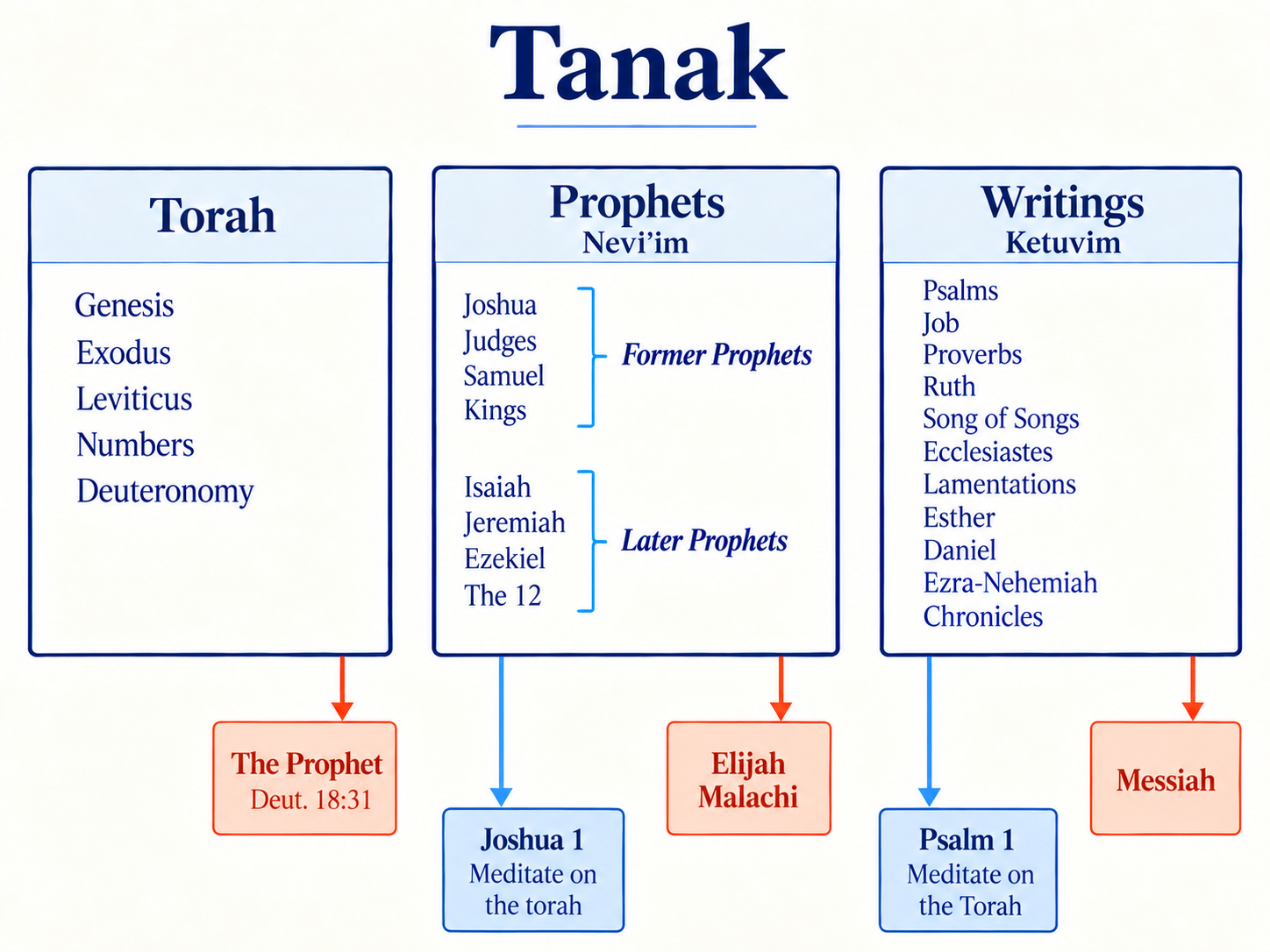
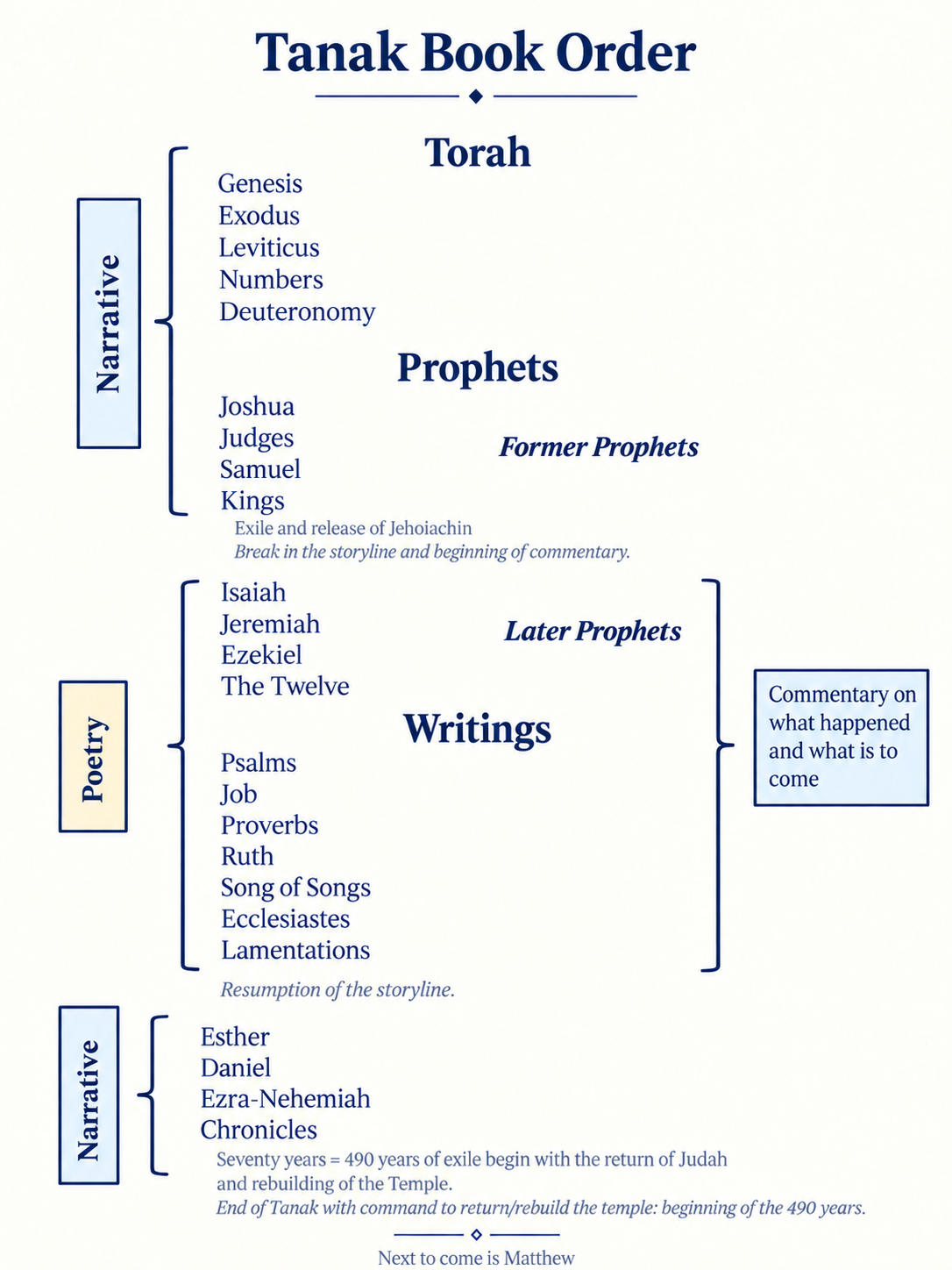
| TORAH | PROPHETS | WRITINGS | |
|---|---|---|---|
| Beginning | Genesis | Joshua 1 | Psalms 1–2 |
| Opening emphasis | Foundation of the story | Meditate on Torah day and night | Torah-shaped righteous one + YHWH’s king |
| Role | Creation, promise, covenant | Israel’s life under covenant | Worship, wisdom, suffering, faithfulness, hope |
| Ending horizon | Deuteronomy 34 | The Twelve / Malachi | Chronicles |
| Looks forward to | A prophet like Moses | Elijah / Day of YHWH / restoration | Return, temple, kingdom — story still open |
| NARRATIVE | POETIC / PROPHETIC INTERPRETATION | EPILOGUE / RESUMED STORY |
|---|---|---|
| Genesis → Kings | Later Prophets + much of the Writings | Esther → Daniel → Ezra–Nehemiah → Chronicles |
| What happened? | What does it mean? Why judgment? What will YHWH do? | Where has the story arrived — and what remains unresolved? |
| Promise, covenant, kingdom, failure, exile | Judgment, wisdom, worship, Messiah, restoration | Return and preservation, yet continuing expectation |
| Division | Closing Horizon | Key Text |
|---|---|---|
| Torah | A coming prophet like Moses | Deut. 18:15–18; 34:10–12 |
| Prophets | Elijah before the Day of YHWH | Mal. 4:4–6 |
| Writings | Return and temple restoration; the story remains open | 2 Chron. 36:22–23 |
| Covenant | Main Texts | Central Promise / Function | Carries Forward |
|---|---|---|---|
| Noahic | Gen. 8–9 | Creation preserved after judgment | Stable world for God’s redemptive purpose |
| Abrahamic | Gen. 12; 15; 17; 22 | Seed, land, blessing, nations | People, land, worldwide blessing |
| Sinai | Exod. 19–24 | Israel formed as a covenant nation under Torah | Holiness, obedience, blessing and curse |
| Davidic | 2 Sam. 7 | Enduring house, throne, and seed | Messianic kingship |
| New Covenant | Deut. 29–30; Jer. 31; Ezek. 36–37 | Forgiveness, changed heart, Spirit, restoration | A faithful people able to live with YHWH |
| Day | Reading | Reading Move |
|---|---|---|
| Mon | ◆ Luke 24:13–49 | Notice the Law, Prophets, and Psalms/Writings as a whole. |
| Tue | ◆ Joshua 1:1–9 ↔ Psalms 1–2 | Compare Torah, meditation day and night, success, and kingship. |
| Wed | ◆ Deut. 18:15–22; 34:9–12 ↔ Mal. 4:4–6 ↔ 2 Chron. 36:22–23 | Watch how the three divisions end looking forward. |
| Thu | ◆ Genesis 1–3 | Watch narrative, poetic speech/oracle, and epilogue-like conclusions at a small scale. |
| Fri | ◆ Genesis 49–50 ↔ Numbers 24 | Watch poetry near narrative conclusions and the developing ruler/seed expectation. |
Joshua 1:7–8 and Psalm 1:1–3 — Why do the Prophets and Writings begin by pointing the reader back to Torah?
Joshua 1:7-8; Psalm 1-2; Deuteronomy 18:15-18; Malachi 4:4-6
What did I learn or was challenging?
How did this draw me closer to God/Jesus or make me feel uncomfortable?
How can I use Head and Heart to minister to others?
Where is Jesus asking me to follow Him?
Use HEAD, HEART, HANDS, and STORY each day as you work through the week's reading.
Entries are saved automatically when signed in.
Core Old Testament vocabulary for this week.
Explain each term in your own words and connect it to this week’s Old Testament reading.
Torah • Prophets • Writings
We begin at the beginning: creation, humanity as God’s image, rebellion, exile from Eden, violence, flood, and the scattering of the nations.
The human problem grows while YHWH remains Creator, Judge, Preserver, and the source of blessing.
Read for repeated patterns: blessing and curse, seed, land, exile, death, eastward movement, and the spread of sin.
| Day | Reading | Reading Move |
|---|---|---|
| Mon | ● Genesis 1–3 | Creation, image, command, rebellion, exile. |
| Tue | ● Genesis 4–6 | Cain, civilization, violence, and the growth of corruption. |
| Wed | ● Genesis 7–9 | Flood, judgment, preservation, covenant. |
| Thu | ● Genesis 10–11 | Nations and Babel. |
| Fri | ◆ Genesis 12–13 | The call of Abram begins YHWH’s answer to the nations. |
Genesis 12:1–3 — How will YHWH answer the problem of Genesis 3–11?
Watch how Genesis repeatedly moves through narrative toward speeches, blessings, curses, and forward-looking words.
↔ Connect Genesis 12:1–3 back to Genesis 10–11: the nations are scattered, then YHWH promises blessing to all families through Abram.
After judgment, YHWH preserves creation and humanity so His redemptive purpose can continue.
Faith begins by trusting YHWH’s word enough to go where He sends.
Genesis 12:1-3
What did I learn or was challenging?
How did this draw me closer to God/Jesus or make me feel uncomfortable?
How can I use Head and Heart to minister to others?
Where is Jesus asking me to follow Him?
Use HEAD, HEART, HANDS, and STORY each day as you work through the week's reading.
Entries are saved automatically when signed in.
Core Old Testament vocabulary for this week.
Explain each term in your own words and connect it to this week’s Old Testament reading.
Torah • Prophets • Writings
The story narrows from the nations to one family through whom YHWH promises seed, land, and blessing.
Abraham’s story teaches promise, faith, covenant, testing, intercession, and YHWH’s faithfulness.
Pay attention to repeated promises and to moments when Abraham trusts, fears, succeeds, and fails.
| Day | Reading | Reading Move |
|---|---|---|
| Mon | ● Genesis 14–16 | Kings, Melchizedek, covenant promise, Hagar. |
| Tue | ◆ Genesis 17–18 | Covenant sign, promised son, YHWH’s purpose. |
| Wed | ● Genesis 19–21 | Judgment, preservation, Isaac. |
| Thu | ◆ Genesis 22–23 | Testing, substitution, oath, burial in the land. |
| Fri | ● Genesis 24–26 | Promise continues through Isaac. |
Genesis 15:1–6 and 22:15–18 — What does Abraham believe, and what does YHWH promise?
Notice how the Abraham narrative repeatedly pauses for covenant speeches and promises that interpret the events.
↔ Connect Genesis 12:1–3; 15; 17; 22. Track land, seed, blessing, and nations.
YHWH promises seed, land, blessing, and blessing to the nations. These promises become major coordinates for the rest of Scripture.
Faith is not passive agreement; it is trusting YHWH’s promise in the midst of delay and uncertainty.
Genesis 12:1-4; 15:1-6; 22:1-18
What did I learn or was challenging?
How did this draw me closer to God/Jesus or make me feel uncomfortable?
How can I use Head and Heart to minister to others?
Where is Jesus asking me to follow Him?
Use HEAD, HEART, HANDS, and STORY each day as you work through the week's reading.
Entries are saved automatically when signed in.
Core Old Testament vocabulary for this week.
Explain each term in your own words and connect it to this week’s Old Testament reading.
Torah • Prophets • Writings
The promise continues through a deeply flawed family. YHWH remains faithful even while Jacob’s household struggles with deception, rivalry, and sin.
Election and grace do not mean the chosen family is morally impressive. YHWH carries His promise through them.
Watch the recurring themes of blessing, firstborn reversal, deception, providence, and preservation.
| Day | Reading | Reading Move |
|---|---|---|
| Mon | ● Genesis 27–29 | Blessing, exile, Bethel, marriages. |
| Tue | ● Genesis 30–32 | Growth, return, wrestling with God. |
| Wed | ● Genesis 33–35 | Reconciliation, return, covenant renewal. |
| Thu | ● Genesis 36–37 | Esau’s line and Joseph’s descent. |
| Fri | ● Genesis 38–39 | Judah and Tamar; Joseph in Egypt. |
Genesis 28:10–22 — How does YHWH reaffirm the Abrahamic promise to Jacob?
The family story keeps moving toward a future blessing larger than the immediate characters.
↔ Connect Genesis 37–38: Joseph’s descent and Judah’s failure stand side by side before both stories develop toward transformation.
YHWH’s faithfulness is greater than the weakness and sinfulness of His people.
Genesis 32-33
What did I learn or was challenging?
How did this draw me closer to God/Jesus or make me feel uncomfortable?
How can I use Head and Heart to minister to others?
Where is Jesus asking me to follow Him?
Use HEAD, HEART, HANDS, and STORY each day as you work through the week's reading.
Entries are saved automatically when signed in.
Core Old Testament vocabulary for this week.
Explain each term in your own words and connect it to this week’s Old Testament reading.
Torah • Prophets • Writings
Genesis ends in Egypt, not in the promised land. Yet YHWH preserves the family and speaks of a coming ruler from Judah.
Providence, forgiveness, preservation, and messianic hope bring Genesis to an intentionally unfinished ending.
Read Joseph’s story as more than biography. Watch how YHWH preserves the seed and transforms Judah.
| Day | Reading | Reading Move |
|---|---|---|
| Mon | ● Genesis 40–42 | Joseph rises; famine brings the brothers. |
| Tue | ● Genesis 43–45 | Judah changes; Joseph reveals himself. |
| Wed | ● Genesis 46–47 | Israel enters Egypt. |
| Thu | ◆ Genesis 48–49 | Blessings over the sons; focus on Judah. |
| Fri | ● Genesis 50 | Burial, forgiveness, Joseph’s death and future hope. |
Genesis 49:8–12 — What kind of future is attached to Judah?
Genesis is largely narrative, but Jacob’s climactic poem in chapter 49 interprets the family’s future before chapter 50 closes the book.
↔ Connect Genesis 49:10 with Numbers 24:17. Watch for the ruler/scepter theme as Torah continues.
Providence means YHWH can remain faithful to His purposes even through human evil and suffering.
Genesis 39-41; 45:4-8; 50:15-21
What did I learn or was challenging?
How did this draw me closer to God/Jesus or make me feel uncomfortable?
How can I use Head and Heart to minister to others?
Where is Jesus asking me to follow Him?
Use HEAD, HEART, HANDS, and STORY each day as you work through the week's reading.
Entries are saved automatically when signed in.
Core Old Testament vocabulary for this week.
Explain each term in your own words and connect it to this week’s Old Testament reading.
Torah • Prophets • Writings
The family of Genesis becomes an enslaved people. YHWH remembers His covenant and reveals His name as He acts to rescue Israel.
Redemption displays YHWH’s identity, power, covenant faithfulness, judgment, and mercy.
Watch for repeated statements about knowing YHWH, hardening, signs, Passover, substitution, and deliverance.
| Day | Reading | Reading Move |
|---|---|---|
| Mon | ● Exodus 1–2 | Slavery, preservation, Moses. |
| Tue | ◆ Exodus 3–4 | YHWH reveals His name and commissions Moses. |
| Wed | ● Exodus 5–7 | Conflict with Pharaoh begins. |
| Thu | ● Exodus 8–10 | Plagues and the exposure of Egypt’s power. |
| Fri | ◆ Exodus 11–12 | Passover and deliverance. |
Exodus 3:13–15 — What does YHWH reveal about Himself?
The exodus story repeatedly explains its own purpose: Egypt, Israel, and the nations are to know who YHWH is.
↔ Connect Exodus 2:24 with Genesis 15 and 17: YHWH remembers His covenant promises.
Redemption begins with God’s action before it becomes Israel’s calling to obedience.
Exodus 2:23-25; 3:7-10
What did I learn or was challenging?
How did this draw me closer to God/Jesus or make me feel uncomfortable?
How can I use Head and Heart to minister to others?
Where is Jesus asking me to follow Him?
Use HEAD, HEART, HANDS, and STORY each day as you work through the week's reading.
Entries are saved automatically when signed in.
Core Old Testament vocabulary for this week.
Explain each term in your own words and connect it to this week’s Old Testament reading.
Torah • Prophets • Writings
YHWH brings His redeemed people to Sinai. Israel receives covenant instruction, yet the golden calf exposes the problem of the human heart almost immediately.
The central question becomes: how can holy YHWH dwell among a sinful covenant people?
Follow the narrative spine through the legal material: arrival, covenant, Moses on the mountain, rebellion, mediation, renewal, and glory-filled tabernacle.
| Day | Reading | Reading Move |
|---|---|---|
| Mon | ● Exodus 13–15 | Departure, sea, song. |
| Tue | ● Exodus 16–20 | Wilderness provision and arrival at Sinai. |
| Wed | ◆ Exodus 24 ○ Exodus 21; 25; 28–29 | Covenant ratification; sample the law, sanctuary, and priesthood material. |
| Thu | ◆ Exodus 32–34 | Golden calf, intercession, covenant renewal. |
| Fri | ◆ Exodus 40 | YHWH’s glory fills the tabernacle. |
Exodus 32–34 — What happens to the covenant almost as soon as it is made?
The legal collections do not replace the story; they are embedded inside it. Track the Sinai event across the book.
↔ Connect Exodus 29:45–46 with Exodus 40:34–38: the goal is YHWH dwelling among His people.
The redeemed people are brought into covenant life under Torah. Redemption comes before covenant obligation.
Grace does not make holiness unnecessary; it makes covenant relationship possible after failure.
Exodus 19:3-6; 20:1-17
What did I learn or was challenging?
How did this draw me closer to God/Jesus or make me feel uncomfortable?
How can I use Head and Heart to minister to others?
Where is Jesus asking me to follow Him?
Use HEAD, HEART, HANDS, and STORY each day as you work through the week's reading.
Entries are saved automatically when signed in.
Core Old Testament vocabulary for this week.
Explain each term in your own words and connect it to this week’s Old Testament reading.
Torah • Prophets • Writings
Leviticus explains life near a holy God; Numbers then shows how quickly the wilderness generation distrusts Him.
Sacrifice, priesthood, holiness, and atonement answer the problem of sinful people living near YHWH, but ritual alone does not create a faithful heart.
Do not get lost in every regulation. Ask what each selected section teaches about holiness, access, atonement, and covenant life.
| Day | Reading | Reading Move |
|---|---|---|
| Mon | ● Leviticus 1; 8–9 | Sacrifice and priesthood. |
| Tue | ◆ Leviticus 10; 16 | Holy worship and the Day of Atonement. |
| Wed | ● Leviticus 17; 19 | Life/blood and holiness in ordinary life. |
| Thu | ● Leviticus 23; 26 | Sacred time; blessing, curse, exile. |
| Fri | ◆ Numbers 11–14 | Complaining, rebellion, spies, unbelief. |
Leviticus 16 — How is atonement made so that YHWH may continue dwelling among His people?
Leviticus 26 prepares us to understand later exile: covenant judgment was announced long before Kings.
↔ Connect Leviticus 26 with Deuteronomy 28 and later 2 Kings 17, 24–25.
Sacrifice, holiness, worship, blessing, curse, and exile explain what covenant life with a holy God requires.
Living near YHWH requires reverence, trust, holiness, and dependence on His provision for sin.
Leviticus 16; 19; 26
What did I learn or was challenging?
How did this draw me closer to God/Jesus or make me feel uncomfortable?
How can I use Head and Heart to minister to others?
Where is Jesus asking me to follow Him?
Use HEAD, HEART, HANDS, and STORY each day as you work through the week's reading.
Entries are saved automatically when signed in.
Core Old Testament vocabulary for this week.
Explain each term in your own words and connect it to this week’s Old Testament reading.
Torah • Prophets • Writings
The wilderness generation continues to rebel, yet in the middle of failure YHWH places remarkable words of blessing and future kingship in Balaam’s mouth.
Human unfaithfulness does not cancel YHWH’s promise.
Notice the contrast between Israel’s actual behavior and the future described in the Balaam oracles.
| Day | Reading | Reading Move |
|---|---|---|
| Mon | ● Numbers 16–17 | Korah’s rebellion and Aaron’s priesthood. |
| Tue | ● Numbers 20–21 | Moses’ failure, Aaron’s death, bronze serpent. |
| Wed | ◆ Numbers 22–23 | Balaam is hired to curse but blesses. |
| Thu | ◆ Numbers 24–25 | Star and scepter; then Israel sins. |
| Fri | ● Numbers 27; 32–34 | Joshua commissioned; land comes into view. |
Numbers 24:15–19 — Who is the coming star and scepter?
A long wilderness narrative reaches a poetic high point in Balaam’s oracles, which interpret the future before the narrative resumes.
↔ Connect Numbers 24:17 with Genesis 49:10.
Our failures do not make YHWH’s promises uncertain; they expose how much fulfillment depends upon Him.
Numbers 24:15-19; 25:1-9
What did I learn or was challenging?
How did this draw me closer to God/Jesus or make me feel uncomfortable?
How can I use Head and Heart to minister to others?
Where is Jesus asking me to follow Him?
Use HEAD, HEART, HANDS, and STORY each day as you work through the week's reading.
Entries are saved automatically when signed in.
Core Old Testament vocabulary for this week.
Explain each term in your own words and connect it to this week’s Old Testament reading.
Torah • Prophets • Writings
Moses retells Israel’s story and prepares the second generation to enter the land. Yet Torah closes by revealing a deeper problem than lack of information.
Israel needs more than commands. They need YHWH to act upon the heart.
Listen for remember, hear, love, heart, obey, blessing, curse, exile, return, and the future prophet.
| Day | Reading | Reading Move |
|---|---|---|
| Mon | ● Deuteronomy 1; 4–5 | Retelling the wilderness; covenant and the Ten Words. |
| Tue | ◆ Deuteronomy 6; 8; 10 | Love YHWH, remember, circumcise the heart. |
| Wed | ◆ Deuteronomy 18; 26; 28 | Prophet like Moses; covenant confession; blessing and curse. |
| Thu | ◆ Deuteronomy 29–30 | Covenant failure, exile, return, circumcised heart. |
| Fri | ● Deuteronomy 31–34 | Song, blessing, Moses’ death, unresolved expectation. |
Deuteronomy 29:4 and 30:1–6 — What must YHWH do for His people?
The Torah ends with poetry, blessing, and the statement that the prophet like Moses has not yet arisen.
↔ Keep Deuteronomy 29–30 open later when reading Jeremiah 31 and Ezekiel 36.
Moses anticipates covenant failure, exile, return, and YHWH’s work of circumcising the heart. This becomes the foundation for later New Covenant language.
External instruction is good, but faithful covenant life requires a heart that knows and loves YHWH.
Deuteronomy 6:4-9; 10:12-16; 30:11-14
What did I learn or was challenging?
How did this draw me closer to God/Jesus or make me feel uncomfortable?
How can I use Head and Heart to minister to others?
Where is Jesus asking me to follow Him?
Use HEAD, HEART, HANDS, and STORY each day as you work through the week's reading.
Entries are saved automatically when signed in.
Core Old Testament vocabulary for this week.
Explain each term in your own words and connect it to this week’s Old Testament reading.
Torah • Prophets • Writings
The Prophets begin with Joshua being commanded to meditate on Torah. Israel enters the land promised to Abraham.
The land is gift and covenant responsibility, not merely territory.
Watch how the opening Torah charge governs the book and how Joshua’s closing speeches call Israel to covenant faithfulness.
| Day | Reading | Reading Move |
|---|---|---|
| Mon | ◆ Joshua 1–3 | Torah-shaped leadership and entry into the land. |
| Tue | ● Joshua 4–6 | Memorial, covenant sign, Jericho. |
| Wed | ● Joshua 7–9 | Achan, covenant consequences, Gibeon. |
| Thu | ● Joshua 10–12 | Conquest summary. |
| Fri | ○ Joshua 13–21 ◆ Joshua 23–24 | Scan allotments; read Joshua’s covenant farewell carefully. |
Joshua 1:7–8 — Why does the Prophets section begin by pointing back to Torah?
Joshua’s beginning and ending frame life in the land as covenant life under YHWH’s word.
↔ Connect Joshua 1:7–8 with Psalm 1:1–3.
Courage in Scripture is not self-confidence; it is faithful action rooted in YHWH’s presence and word.
Joshua 1:1-9
What did I learn or was challenging?
How did this draw me closer to God/Jesus or make me feel uncomfortable?
How can I use Head and Heart to minister to others?
Where is Jesus asking me to follow Him?
Use HEAD, HEART, HANDS, and STORY each day as you work through the week's reading.
Entries are saved automatically when signed in.
Core Old Testament vocabulary for this week.
Explain each term in your own words and connect it to this week’s Old Testament reading.
Torah • Prophets • Writings
After Joshua, Israel repeatedly abandons YHWH. The book descends from compromised faithfulness into social and moral chaos.
The repeated cycles show covenant unfaithfulness and the inadequacy of Israel’s leaders.
Do not read Judges as a collection of hero stories. Watch the downward spiral and the narrator’s repeated theological judgments.
| Day | Reading | Reading Move |
|---|---|---|
| Mon | ● Judges 1–3 | Incomplete obedience and the cycle begins. |
| Tue | ● Judges 4–8 | Deborah, Gideon, and increasing ambiguity. |
| Wed | ● Judges 13–16 | Samson and compromised deliverance. |
| Thu | ● Judges 19–20 | Israel’s moral collapse. |
| Fri | ◆ Judges 21 ↔ Judges 17:6; 18:1; 19:1; 21:25 | The repeated refrain interprets the whole book. |
Judges 21:25 — What happens when covenant people define right for themselves?
The refrain about doing what is right in one’s own eyes is an interpretive key, not a throwaway comment.
↔ Later compare Judges’ refrain with Kings’ repeated question: did the king do what was right in the sight of YHWH?
Freedom from faithful authority becomes slavery to disordered desire.
Judges 17:6; 21:25
What did I learn or was challenging?
How did this draw me closer to God/Jesus or make me feel uncomfortable?
How can I use Head and Heart to minister to others?
Where is Jesus asking me to follow Him?
Use HEAD, HEART, HANDS, and STORY each day as you work through the week's reading.
Entries are saved automatically when signed in.
Core Old Testament vocabulary for this week.
Explain each term in your own words and connect it to this week’s Old Testament reading.
Torah • Prophets • Writings
Israel asks for a king. Saul fails, David rises, and YHWH makes a covenant promise concerning David’s house and throne.
Samuel evaluates kingship through faithfulness to YHWH and frames its story with poetry about YHWH’s king.
Watch Hannah’s song, Saul’s failure, David’s anointing, the covenant of 2 Samuel 7, David’s sin, and the concluding songs.
| Day | Reading | Reading Move |
|---|---|---|
| Mon | ◆ 1 Samuel 1–3; 8 | Hannah, Samuel, and the demand for a king. |
| Tue | ● 1 Samuel 9–10; 15 | Saul chosen and rejected. |
| Wed | ● 1 Samuel 16–17; 31 | David anointed; Goliath; Saul’s end. |
| Thu | ◆ 2 Samuel 5–7 | David’s kingdom, ark, and covenant promise. |
| Fri | ● 2 Samuel 11–12; 22 | David’s failure and concluding song. |
2 Samuel 7:8–16 — What does YHWH promise concerning David’s house, throne, and seed?
Hannah’s song near the beginning and David’s song near the end help frame Samuel’s message about YHWH’s king and anointed one.
↔ Connect 1 Samuel 2:10; 2 Samuel 7; 22:51.
YHWH promises David an enduring house, throne, and seed. The promise intensifies the Old Testament’s expectation of a coming king.
Leadership is judged by faithfulness to YHWH, not merely gifting, charisma, or success.
1 Samuel 3:1-21; 15:22-23
What did I learn or was challenging?
How did this draw me closer to God/Jesus or make me feel uncomfortable?
How can I use Head and Heart to minister to others?
Where is Jesus asking me to follow Him?
Use HEAD, HEART, HANDS, and STORY each day as you work through the week's reading.
Entries are saved automatically when signed in.
Core Old Testament vocabulary for this week.
Explain each term in your own words and connect it to this week’s Old Testament reading.
Torah • Prophets • Writings
Solomon’s kingdom reaches remarkable glory, then fractures. Kings evaluates ruler after ruler until both Israel and Judah go into exile.
The history is theological history. Kings asks whether rulers do what is right in YHWH’s sight.
Mark every royal evaluation you encounter. Compare political success with the narrator’s covenant judgment.
| Day | Reading | Reading Move |
|---|---|---|
| Mon | ● 1 Kings 1–3; 8 | Solomon, wisdom, temple. |
| Tue | ◆ 1 Kings 11–12 | Solomon’s failure and the divided kingdom. |
| Wed | ● 1 Kings 17–19 | Elijah and the contest over who is truly God. |
| Thu | ◆ 2 Kings 17–18 | Fall of Israel and the theological explanation. |
| Fri | ◆ 2 Kings 22–25 | Josiah, final decline, fall of Jerusalem, exile. |
2 Kings 17:7–23 — Why did the northern kingdom fall?
Repeated royal formulas interpret the history: rulers are measured by YHWH’s covenant standard.
↔ Connect Judges 21:25 with the royal evaluations in Kings; then connect 2 Kings 17 and 25 with Leviticus 26 and Deuteronomy 28.
Visible success can conceal covenant failure. YHWH’s evaluation is the one that finally matters.
1 Kings 11:1-13; 2 Kings 17:7-23
What did I learn or was challenging?
How did this draw me closer to God/Jesus or make me feel uncomfortable?
How can I use Head and Heart to minister to others?
Where is Jesus asking me to follow Him?
Use HEAD, HEART, HANDS, and STORY each day as you work through the week's reading.
Entries are saved automatically when signed in.
Core Old Testament vocabulary for this week.
Explain each term in your own words and connect it to this week’s Old Testament reading.
Torah • Prophets • Writings
The Later Prophets now interpret the collapse we have watched in Kings. Isaiah announces judgment while also unveiling YHWH’s answer.
The same covenant God who judges sin promises a coming king, servant, restoration, and salvation reaching the nations.
Read prophecy as covenant interpretation and future hope, not merely a list of disconnected predictions.
| Day | Reading | Reading Move |
|---|---|---|
| Mon | ● Isaiah 1; 5–6 | Covenant indictment and the holy King. |
| Tue | ◆ Isaiah 7–9 | Immanuel and the promised ruler. |
| Wed | ◆ Isaiah 10–12 | Judgment, remnant, branch from Jesse. |
| Thu | ● Isaiah 40–42 | Comfort, YHWH’s greatness, the Servant. |
| Fri | ◆ Isaiah 49; 52–53 | Servant, nations, suffering and exaltation. |
Isaiah 11:1–10 — What kind of king comes from Jesse, and what does His reign accomplish?
The poetry of the Later Prophets interprets Israel’s covenant history and points beyond judgment toward YHWH’s own solution.
↔ Connect Isaiah’s covenant accusations to Deuteronomy; connect Isaiah 11 to 2 Samuel 7.
Hope is not denial of judgment. Biblical hope grows from confidence that YHWH will act faithfully after judgment.
Isaiah 11:1-10; 42:1-9; 49:1-6
What did I learn or was challenging?
How did this draw me closer to God/Jesus or make me feel uncomfortable?
How can I use Head and Heart to minister to others?
Where is Jesus asking me to follow Him?
Use HEAD, HEART, HANDS, and STORY each day as you work through the week's reading.
Entries are saved automatically when signed in.
Core Old Testament vocabulary for this week.
Explain each term in your own words and connect it to this week’s Old Testament reading.
Torah • Prophets • Writings
Jeremiah and Ezekiel speak into the collapse and exile of Judah. They explain the judgment from Torah and look toward YHWH’s transforming work.
Restoration requires more than return to the land: new covenant, new heart, Spirit, shepherd, and renewed people.
Keep Deuteronomy 29–30 in view. Notice how the prophets reuse its categories.
| Day | Reading | Reading Move |
|---|---|---|
| Mon | ● Jeremiah 1; 7; 23 | Prophetic calling, temple false confidence, righteous Branch. |
| Tue | ● Jeremiah 25; 29–30 | Judgment, exile, future restoration. |
| Wed | ◆ Jeremiah 31–33 | New covenant and Davidic hope. |
| Thu | ● Ezekiel 1; 10–11; 34 | Glory, judgment, shepherd promise. |
| Fri | ◆ Ezekiel 36–37 | New heart, Spirit, resurrection imagery, one Davidic shepherd. |
Jeremiah 31:31–34 and Ezekiel 36:22–28 — What does YHWH promise to do that Israel could not do for itself?
The Later Prophets read Israel’s exile through Torah and then project Torah’s own restoration promises into the future.
↔ Connect Deuteronomy 29:4; 30:1–6 with Jeremiah 31 and Ezekiel 36.
The Prophets develop Deuteronomy’s horizon: forgiveness, inward Torah, new heart, Spirit, restoration, and renewed Davidic shepherding.
Transformation is ultimately rooted in YHWH’s gracious work upon and within His people.
Deuteronomy 29:4; 30:1-6; Jeremiah 31:31-34; Ezekiel 36:22-28
What did I learn or was challenging?
How did this draw me closer to God/Jesus or make me feel uncomfortable?
How can I use Head and Heart to minister to others?
Where is Jesus asking me to follow Him?
Use HEAD, HEART, HANDS, and STORY each day as you work through the week's reading.
Entries are saved automatically when signed in.
Core Old Testament vocabulary for this week.
Explain each term in your own words and connect it to this week’s Old Testament reading.
Torah • Prophets • Writings
The Book of the Twelve gathers many prophetic voices around covenant unfaithfulness, judgment, repentance, the nations, and future hope.
YHWH’s judgment is morally serious, yet His covenant mercy and kingdom purpose continue.
Do not try to master every historical detail this week. Listen for recurring covenant language and future hope.
| Day | Reading | Reading Move |
|---|---|---|
| Mon | ● Hosea 1–3; 11 | Covenant unfaithfulness and faithful love. |
| Tue | ● Amos 5; 7–9 | Justice, judgment, David’s fallen booth. |
| Wed | ● Jonah 1–4 | YHWH’s mercy toward the nations. |
| Thu | ◆ Micah 5; Habakkuk 2; Zechariah 9 | Ruler, faith, coming king. |
| Fri | ◆ Malachi 4 | Torah, Elijah, and the coming Day of YHWH. |
Malachi 4:4–6 — How does the Prophets section close by looking backward to Moses and forward to Elijah?
The Twelve close the Prophets with Torah remembrance and future expectation.
↔ Connect Malachi 4 with Joshua 1 at the opening of the Prophets and with John 1’s questions about Messiah, Elijah, and the Prophet.
Faithfulness includes justice, mercy, repentance, and confidence in YHWH even when His promises seem delayed.
Hosea 11; Amos 5; Jonah 4; Micah 6:6-8
What did I learn or was challenging?
How did this draw me closer to God/Jesus or make me feel uncomfortable?
How can I use Head and Heart to minister to others?
Where is Jesus asking me to follow Him?
Use HEAD, HEART, HANDS, and STORY each day as you work through the week's reading.
Entries are saved automatically when signed in.
Core Old Testament vocabulary for this week.
Explain each term in your own words and connect it to this week’s Old Testament reading.
Torah • Prophets • Writings
The Writings begin with Psalms, where Torah and YHWH’s anointed king stand together. Job then explores wise covenant faithfulness amid undeserved suffering.
The righteous life is rooted in Torah, fear of YHWH, trust, worship, and hope in His king.
Notice how Psalms 1–2 function as an entrance to the Psalter and how Job’s structure moves from prose into poetry and back to prose.
| Day | Reading | Reading Move |
|---|---|---|
| Mon | ◆ Psalms 1–2; 8 | Torah, king, humanity. |
| Tue | ● Psalms 19; 22–23 | Torah, suffering, shepherd. |
| Wed | ● Psalms 51; 72; 89 | Repentance and Davidic kingship. |
| Thu | ◆ Psalm 110; Job 1–2 | Priest-king hope; the righteous sufferer. |
| Fri | ◆ Job 28; 38; 42 | Wisdom, YHWH’s answer, epilogue. |
Job 28:28 — Where is wisdom found?
Job itself displays a prose–poetry–prose shape; Psalm 1 and Psalm 2 place Torah and Messiah together at the entrance to the Writings.
↔ Connect Job 28:28 with Proverbs 1:7 next week.
Faithful wisdom trusts YHWH’s wisdom even when circumstances do not provide simple answers.
Psalms 22-23; Job 1-2; 28:28; 38-42
What did I learn or was challenging?
How did this draw me closer to God/Jesus or make me feel uncomfortable?
How can I use Head and Heart to minister to others?
Where is Jesus asking me to follow Him?
Use HEAD, HEART, HANDS, and STORY each day as you work through the week's reading.
Entries are saved automatically when signed in.
Core Old Testament vocabulary for this week.
Explain each term in your own words and connect it to this week’s Old Testament reading.
Torah • Prophets • Writings
Proverbs describes wise covenant life rooted in the fear of YHWH. Ruth then gives us a concrete picture of faithful wisdom in ordinary suffering and loyalty.
Biblical wisdom is not mere cleverness; it is life ordered rightly before YHWH.
Read the end of Proverbs and the story of Ruth together. Pay attention to the language of the excellent woman.
| Day | Reading | Reading Move |
|---|---|---|
| Mon | ◆ Proverbs 1–3 | The fear of YHWH and the path of wisdom. |
| Tue | ● Proverbs 8–9 | Wisdom’s call and the two ways. |
| Wed | ◆ Proverbs 31 | The excellent woman who fears YHWH. |
| Thu | ◆ Ruth 1–2 | Covenant loyalty in grief and poverty. |
| Fri | ◆ Ruth 3–4 | Ruth as excellent woman; redemption; Davidic genealogy. |
Proverbs 31:30 and Ruth 3:11 — How does Ruth embody the wisdom Proverbs describes?
Canonical proximity helps interpretation: Job asks about wisdom, Proverbs teaches wisdom, and Ruth embodies wisdom.
↔ Connect Job 28:28 → Proverbs 1:7 → Proverbs 31:30 → Ruth 3:11.
Wisdom becomes visible in ordinary faithfulness, courage, generosity, work, loyalty, and fear of YHWH.
Proverbs 31:10-31; Ruth 1:6-18; 2:8-12; 3:10-11
What did I learn or was challenging?
How did this draw me closer to God/Jesus or make me feel uncomfortable?
How can I use Head and Heart to minister to others?
Where is Jesus asking me to follow Him?
Use HEAD, HEART, HANDS, and STORY each day as you work through the week's reading.
Entries are saved automatically when signed in.
Core Old Testament vocabulary for this week.
Explain each term in your own words and connect it to this week’s Old Testament reading.
Torah • Prophets • Writings
The final Writings explore life under empire, preservation in exile, return, temple, Torah renewal, and the retelling of Israel’s story. Yet the canon ends without complete restoration.
Return from Babylon is real, but the deeper promises of transformed hearts, universal kingdom, and final Davidic restoration remain open.
Read these books with two questions: How does a faithful person live in exile? And what is still unresolved when Chronicles ends?
| Day | Reading | Reading Move |
|---|---|---|
| Mon | ● Esther 1–4; 7–9 | Providence and preservation in dispersion. |
| Tue | ● Daniel 1; 3; 6 | Faithfulness under pagan empire. |
| Wed | ◆ Daniel 7; 9 | Son of Man, kingdom, exile and restoration. |
| Thu | ● Ezra 1; Nehemiah 8; 1 Chronicles 17 | Return, Torah renewal, Davidic promise retold. |
| Fri | ◆ 2 Chronicles 36 | Judgment, exile, Cyrus, and an open ending. |
2 Chronicles 36:22–23 — Why is this an appropriate ending to the Tanakh?
Chronicles retells the story and ends with return authorized but not fulfillment completed. The story remains open toward what YHWH will yet do.
↔ Connect 2 Chronicles 36 back to Genesis 12, 2 Samuel 7, Deuteronomy 30, Jeremiah 31, Ezekiel 36–37, and Psalms 1–2.
By the end of the Tanakh, YHWH has remained faithful to His covenant purposes, but the full realization of transformed hearts, worldwide blessing, and enduring Davidic rule is still awaited.
Faithfulness often means living faithfully inside a story whose promised ending we have not yet seen.
Esther 4:13-16; Daniel 1; 3; 6
What did I learn or was challenging?
How did this draw me closer to God/Jesus or make me feel uncomfortable?
How can I use Head and Heart to minister to others?
Where is Jesus asking me to follow Him?
Use HEAD, HEART, HANDS, and STORY each day as you work through the week's reading.
Entries are saved automatically when signed in.
Core Old Testament vocabulary for this week.
Explain each term in your own words and connect it to this week’s Old Testament reading.
Trace the Story • Trace the Canon • Trace the Hope
In your own words, explain how the Old Testament moves from creation to an unresolved expectation at the end of Chronicles.
Explain what the Torah establishes, what the Prophets interpret, and what the Writings explore.
Choose three passages from different sections of the Tanakh and explain how they contribute to the developing expectation of YHWH’s coming king, prophet, servant, shepherd, kingdom, or restored people.
What are we still waiting for when the Old Testament ends?
The recurring rhythm behind the course is not simply to learn about Scripture, but to read it, understand it, receive from the Lord through it, and respond faithfully.
Living the Story: A Scripture Apprenticeship Framework
Learning to live inside the story of Scripture
What is this?
This course is designed to help students do more than learn about the Bible.
It trains them to read Scripture, understand it, and respond to it.
Students are not simply studying information—they are learning to live inside the story of Scripture.
This framework shapes how students engage every subject within Achten Häus.
What are students learning to do?
Read Scripture carefully and consistently
See what the text reveals about Jesus
Understand how each passage fits within the whole story
Receive by slowing down and listening to God through His Word
Respond by following Christ in everyday life
How does this work?
reading passages regularly
observing what is in the text
understanding key ideas and structure
discussing meaning and implications
responding in practical ways
Students are not only learning—they are practicing how to live in response to God.
What makes this different?
Many Bible programs focus primarily on information or experience alone.
This framework brings both together.
structured — following the shape and flow of each book
Christ-centered — seeing how all Scripture points to Him
formational — allowing truth to shape real life
What is the goal?
To form students who can read the Bible, recognize Christ, receive from Him, and follow Him.
This is not simply a course of study.
It is training in a way of life.
In Verbo Vivimus
In the Word we live
This project is an opportunity to show what you have learned in the New Testament course.
Your goal is not simply to repeat information.
Choose one of the following project options.
Choose a passage from the New Testament and explain it.
Choose a theme that appears in the New Testament and trace it through several books.
Choose two Gospels and compare how they present Jesus.
Create a visual project that shows the structure, movement, or message of the New Testament.
Your project should make the meaning of Scripture visible.
Include a short written or spoken explanation of what your visual shows.
Write a reflection on how this course has shaped the way you read Scripture and follow Jesus.
Whatever option you choose, your project should show:
Choose one project option above and submit one finished document. Word and PDF files are accepted.
This project is not simply a final assignment.
It is an opportunity to show that you are learning to read, understand, and live inside the story of Scripture.
This project is an opportunity to show what you have learned in the Old Testament course.
Your goal is not simply to repeat information.
Choose one of the following project options.
Choose a passage from the Old Testament and explain it.
Choose a theme that appears across the Old Testament and trace it through several books.
Choose one major Old Testament covenant and show how it develops within the larger story.
Create a visual project that shows the structure, movement, or message of the Old Testament.
Your project should make the meaning of Scripture visible.
Include a short written or spoken explanation of what your visual shows.
Write a reflection on how this course has shaped the way you read the Old Testament and live inside the story of Scripture.
Whatever option you choose, your project should show:
Choose one project option above and submit one finished document. Word and PDF files are accepted.
This project is not simply a final assignment.
It is an opportunity to show that you are learning to read, understand, and live inside the story of Scripture.
Class time is designed primarily for guided seeing, understanding, receiving, discussing, and responding—not for a lecture-heavy format.
This is not primarily a lecture.
guiding students to see Scripture clearly
helping them understand what it means
creating space to receive from the Lord
calling them to respond and follow
Primary Formation Thread
Spiritual Life
Apprenticeship Goal
Help students see Jesus as the King worth following.
Hermeneutical Awareness
Matthew presents Jesus as the fulfillment of the Old Testament expectation.
Common Misunderstanding
Students may reduce kingdom teaching to moral rules instead of seeing it as life under Jesus’ kingship.
CLASS FLOW (1.5 HOURS)
OPENING (0:00–0:10)
Orient students to the passage and prepare their posture
brief welcome
short prayer
orient them to the text
Here’s where we are in the story
This section is showing us
Watch for this as we read
READING THE TEXT (0:10–0:25)
Let students hear and see Scripture
read aloud (you and/or students)
slow the pace
don’t explain yet
Pay attention—what stands out?
OBSERVE (0:25–0:45)
Help students see what is actually in the text
What did you notice?
What repeats?
What stands out?
draw out observations
affirm correct seeing
guide gently
This is where students learn to read
UNDERSTAND (0:45–1:05)
Move from observation to meaning
What does this mean?
Why is this here?
What is the author showing us?
brief clarification
simple explanation (not lecture-heavy)
Explain that in your own words
Builds understanding + leadership
DISCUSS (1:05–1:20)
Connect the text to life and to Christ
What does this show about Jesus?
Where do we see ourselves in this?
How do people respond to this truth?
How could this help someone else?
Builds awareness + care
Receive (Woven Throughout, 1–2 Moments)
Help students slow down and receive from the Lord
pause for 30–60 seconds
allow silence
What is God showing you?
Keep this simple and brief
No pressure, no technique
Respond (1:20–1:30)
Call students to action
What will you do this week?
Where is Jesus asking you to follow?
one clear response
not many vague ones
Leadership Development (Built in)
speak (observe)
explain (understand)
consider others (discuss)
respond personally
Do not force this—just invite participation
Vocabulary (Story Language)
introduce 1–2 words max
define simply
have students write them
Justification means being made right with God.
Teacher Posture
the primary speaker
the source of all answers
a guide helping students see and respond to Scripture
Keep This in Mind
ask more than you tell
keep explanations simple
point back to the text
create space for response
over-lecture
answer every question immediately
rush through silence
overload with information
Class Goal
Students leave not just understanding the passage,
but seeing Christ and knowing how to follow Him.
Final Reminder
This is not just a class.
It is training students to live inside the story of Scripture.
In Verbo Vivimus
In the Word we live
The website contains the course content, but the original files are included too, so the site can function as a central shelf for your working documents.
Keep the resources folder beside index.html so these links continue to work.
Your personal place in the Achten Häus curriculum. Journal responses and progress are kept separate for each signed-in learner.